
 comparison
Design-Build for Historic Home Renovations: Worth It?
Table of Contents
- Design-Build for Historic Home Renovations: The Verdict
- Design-Build vs. Design-Bid-Build for Historic Homes
- Key Strengths of Design-Build for Historic Properties
- Real Weaknesses: When Design-Build Falls Short
- Managing Historic Preservation Compliance Under Design-Build
- Historic Home Renovation Cost Estimation in Design-Build Projects
- Who Should Choose Design-Build for Historic Renovations
- Conclusion
- Frequently Asked Questions
Last Updated: September 29, 2026
Design-Build for Historic Home Renovations: The Verdict
Are design-build historic home renovations right for your project? It depends on your priorities, budget flexibility, and preservation requirements. Design-build offers integrated teams, fewer change orders, and clearer timelines, but limits design flexibility mid-project.
Design-build works well when you trust an experienced team to balance modern living standards with architectural character. It struggles when homeowners demand exhaustive pre-construction documentation or want to cherry-pick contractors.
Design-Build vs. Design-Bid-Build for Historic Homes
In design-bid-build, you hire an architect first, then bid plans to multiple contractors. You get maximum design control and competitive bidding, but design changes trigger change orders and timelines stretch.
In design-build, one firm handles design and construction as a single team. Budget and timeline lock in early, with one point of accountability.
For historic homes, this matters enormously. Design-build embeds preservation requirements into budget and schedule upfront, avoiding costly mid-project redesigns.
The tradeoff: design-build limits mid-project changes, as major pivots cost more once decisions are integrated into the plan.
| Approach | Design Control | Cost Predictability | Timeline | Best For |
|---|---|---|---|---|
| Design-Build | Moderate (locked early) | High (fewer surprises) | Faster (parallel design-construction) | Budget-conscious, timeline-sensitive projects |
| Design-Bid-Build | High (change easily) | Lower (change orders common) | Longer (sequential phases) | Design-first homeowners, competitive bidding priority |
Key Strengths of Design-Build for Historic Properties
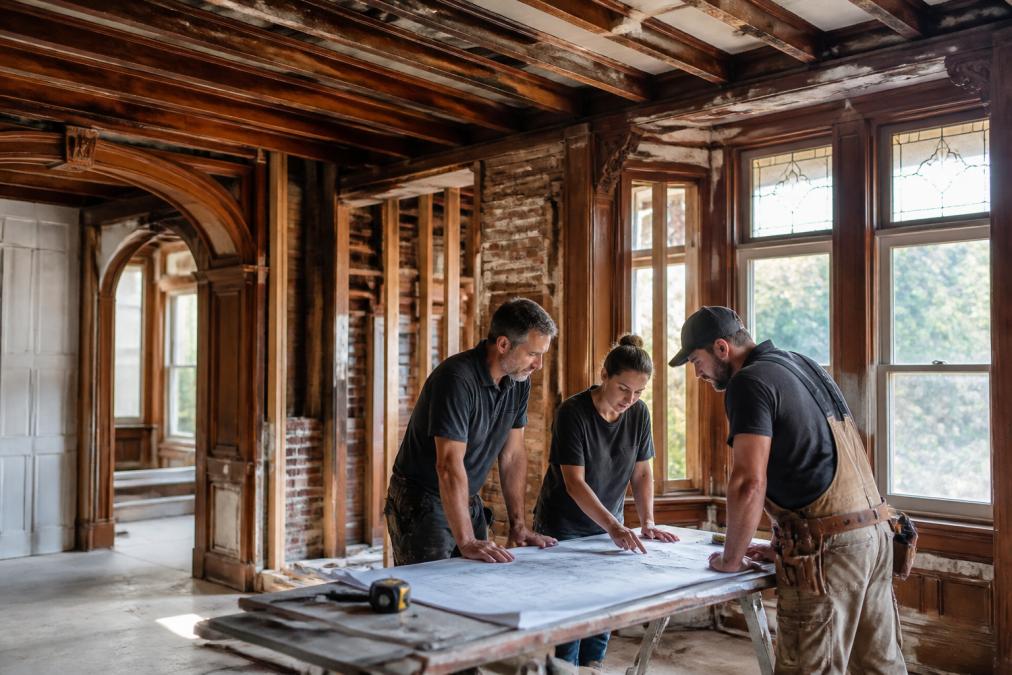
Integrated preservation planning. Preservation requirements get baked into budget and timeline before construction starts. The architect and builder coordinate structural integrity, material sourcing, and code compliance upfront, preventing costly mid-project redesigns.
Fewer change orders. Design-build teams coordinate design with construction feasibility upfront and budget for contingencies, reducing surprises common in historic homes like hidden structural issues and outdated systems.
Clearer accountability. One contract and one point of responsibility eliminates finger-pointing between architect and contractor, critical for historic work where mistakes are costly.
Faster timeline. Design-build runs design and construction in parallel, starting structural work while finishing interior details, reducing total project duration for occupied spaces.
Real Weaknesses: When Design-Build Falls Short
Design-build isn't perfect for every historic renovation. Here are the honest limitations.
Less flexibility for design changes. Major design changes after contract signing cost significantly more, as decisions are already coordinated across budget, timeline, and sequencing.
Requires trust in the team's vision. Design-build works best when you trust the firm's judgment about balancing modern standards with historic character. If you need absolute control over aesthetics, traditional design-bid-build is better.
Premium pricing for smaller projects. Design-build overhead makes it more expensive for renovations under $150,000; traditional contracting is better for small budgets.
Permitting delays in strict historic districts. Some commissions require exhaustive pre-approval documentation, negating design-build's timeline advantage.
Less competitive bidding. You get one price from one team, with no comparison to market rates if overhead or labor costs are high.
Managing Historic Preservation Compliance Under Design-Build
Design-build handles preservation compliance better than traditional contracting, but only if the team understands requirements from day one.
The design-build process should include early site assessment, preservation standards integration with local guidelines, upfront material sourcing for period-accurate pieces, and phasing strategy to maintain occupancy.
The National Park Service publishes preservation standards for historic buildings that many local commissions reference. A competent design-build firm will be familiar with these standards and how they apply to your specific project.
Energy Efficiency vs. Historic Aesthetics: A Core Design-Build Challenge
Balancing energy efficiency with historic character is contentious: modern codes and utility expectations often conflict with preservation standards on windows, insulation, and mechanical systems.
Design-build teams navigate these trade-offs upfront: restoration-grade storm windows (30-50% more than replacement), vapor-permeable insulation to prevent moisture damage, planned ductwork routing or high-velocity systems, and custom enclosures for mechanical systems. Costs lock into the GMP early rather than emerging mid-project.
Material Sourcing for Period-Accurate Repairs
Design-build teams source materials upfront: reclaimed stock (8-12 weeks), custom millwork (6-10 weeks), and specialty suppliers for plaster, hardware, and paints. Material samples are matched during design, preventing mid-project guessing.
Navigating Historic District Commission Approvals
Design-build teams present a unified preservation plan to historic district commissions early, accelerating approval. However, commissions requiring exhaustive documentation may negate design-build's speed advantage. A competent firm assesses local timelines upfront and adjusts the schedule.
Historic Home Renovation Cost Estimation in Design-Build Projects
Design-build addresses cost uncertainty by front-loading contingencies and locking in a guaranteed maximum price (GMP). The process moves from preliminary estimate to refined design development to final GMP once design is substantially complete.
The GMP approach protects you from open-ended costs but includes contingency buffer. For historic homes, GMP usually wins because unknowns are real; contractors bidding without contingency are either inexperienced or planning change orders.
Federal and State Tax Incentives for Historic Restoration
The federal Historic Preservation Tax Credit offers a 20% credit on qualified rehabilitation expenses for homes on the National Register or in registered districts. Qualified expenses include structural repairs, window/door restoration, roofing, interior finishes, and mechanical systems (if preservation-sensitive). A $200,000 project yields a $40,000 credit. Design-build teams familiar with these credits structure projects to maximize qualified expenses and ensure compliance with the Secretary of the Interior's Standards.
State historic preservation tax credits. Many states offer additional tax credits or grants for historic restoration. These vary by state but can range from 10-25% of qualified costs. Some states offer grants (non-repayable funds) rather than credits, which is even more valuable. Check your state historic preservation office (SHPO) for eligibility and application requirements.
Historic Preservation Grants and Funding Programs
Beyond tax credits, several funding sources exist for historic home restoration:
Preservation easement programs. If you place a preservation easement on your property (a legal restriction that protects historic features in perpetuity), you may qualify for a charitable tax deduction equal to the easement's value. This is complex and requires appraisal, but it can provide substantial tax benefits. Design-build teams don't typically manage easements, but they should be aware of this option and refer you to a preservation attorney.
Community development grants. Some municipalities offer grants or low-interest loans for historic home restoration in designated neighborhoods. These are often tied to community revitalization initiatives. Check your local city or county planning department.
National Trust for Historic Preservation funding. The National Trust occasionally offers grants for significant historic restoration projects, particularly those serving public benefit.
Budgeting for Contingencies in Historic Work
Structural surprises. Hidden rot, settling, or failed foundations often emerge during renovation. A typical contingency for historic work is 15-25% of the project cost, compared to 10% for new construction. For a $200,000 project, this means budgeting $30,000-$50,000 for unknowns.
Comparing Design-Build Cost to Traditional Contracting
Design-build typically costs 5-15% more upfront than traditional design-bid-build for the same scope, primarily because the contractor's design coordination and early planning require investment. However, design-build often saves money overall by avoiding change orders and delays.
For a $200,000 historic renovation:
- Design-build GMP: $200,000 (locked in, includes contingency)
- Design-bid-build base bid: $185,000 (lower initial price, but typical change orders add $25,000-$40,000)
- Net cost after change orders: $210,000-$225,000
Who Should Choose Design-Build for Historic Renovations
Design-build makes sense if you match these criteria:
- You prioritize timeline and budget certainty over maximum design flexibility. You're willing to make decisions upfront and stick with them.
- Your project is substantial enough to justify the overhead. Design-build typically makes financial sense for projects over $150,000. Smaller renovations may cost less with traditional contracting.
- You trust the team's judgment about preservation. You want partners who understand historic integrity, not just contractors who follow plans.
- Your local historic district isn't unusually restrictive. If your jurisdiction requires extensive pre-approval documentation, design-build's speed advantage disappears.
- You want to minimize disruption to an occupied space. Design-build's parallel design-construction approach reduces total project duration, which matters if you're living in or operating a business from the property.
- You're comfortable with one point of accountability. You prefer one contract and one relationship over managing multiple vendors.
Design-build is not the right fit if:
- You want to bid out individual components to maximize cost savings.
- You're still exploring design options and expect significant changes mid-project.
- Your budget is under $100,000 and you need every dollar optimized.
- You have a specific architect you want to hire independently.
- Your historic district commission requires exhaustive pre-construction approvals that will delay the project anyway.
Conclusion
Design-build historic home renovations work well when you prioritize integrated planning, timeline certainty, and seamless coordination between design and construction. It's less ideal if you want maximum flexibility or are managing a very small budget.
Frequently Asked Questions
What is a disadvantage of design-build for historic projects?
Design-build reduces flexibility to shop individual components to outside contractors. Once locked into the design-build contract, you have less ability to bring in specialized subcontractors for specific tasks like period-accurate millwork or custom masonry. This can limit your options if you discover mid-project that a particular specialist is better suited for a historic element. Additionally, less transparent pricing structures mean you may not see exactly how costs break down across design, materials, and labor.
Is a design-build approach cost-effective for older homes?
Design-build can reduce overall costs for historic homes by aligning budget and design early, preventing expensive change orders that plague traditional bid-build projects. Integrated teams catch structural surprises during planning rather than mid-construction. However, cost-effectiveness depends on choosing a firm with genuine historic expertise. A design-build team unfamiliar with period-accurate materials or preservation standards may actually increase costs through rework or regulatory delays. Request references from completed historic projects before committing.
How do design-build teams handle unexpected structural issues in historic homes?
Effective design-build firms conduct thorough pre-construction site assessments to identify structural problems before the contract is signed. This includes structural engineering review, material testing, and foundation evaluation. Because the designer and builder are under one contract, unexpected issues discovered during construction are resolved collaboratively without the finger-pointing that occurs in traditional delivery. However, the contract should clearly define what counts as a change order versus what falls under the original scope, particularly for historic homes where surprises are common.
Does design-build help with local historic district board approvals?
Yes, design-build can streamline historic district approvals because the design team and builder work together from the start to ensure compliance with preservation standards. This unified approach reduces the risk of submitting designs that the historic district board will reject, which delays traditional projects significantly. The integrated team can address board concerns during design rather than after construction has already begun. However, the firm must have documented experience with your specific historic district's requirements and submission process.