 how-to
How to Manage General Contractor Relationships: A Pro Guide
Table of Contents
- Step 1: Set Clear Expectations and Define the Scope of Work
- Step 2: Build Trust Through Transparent Communication
- Step 3: Use a General Contractor Meeting Agenda Template for Productive Check-Ins
- Step 4: Master the Construction Change Order Process
- Step 5: Learn How to Handle Contractor Disputes Without Litigation
- Step 6: Use Construction Project Management Software for Real-Time Collaboration
- Step 7: Maintain the Relationship After Project Completion
- Frequently Asked Questions
Last Updated: September 14, 2026
Step 1: Set Clear Expectations and Define the Scope of Work
Learning how to manage general contractor relationships starts before anyone swings a hammer. The single biggest cause of friction on a job site is a scope of work that was never written down clearly enough for both sides to point at the same document.
A vague scope can turn into "that wasn't included" arguments that stall a project for weeks. A written scope should spell out what gets built, what materials are specified, who pulls permits, and what happens when the homeowner requests something outside the original plan.
Build the scope around four anchors:
- Deliverables: Every room, system, and finish item, listed line by line.
- Exclusions: What the contract does not cover, stated as plainly as what it does.
- Payment terms: Draw schedule tied to project milestones, not calendar dates.
- Timeline management: Start date, major milestones, and the process for approving delays.
Step 2: Build Trust Through Transparent Communication
Transparency is the fastest trust-builder available to any general contractor, and it costs nothing but discipline. Homeowners and business owners do not expect a perfect project. They expect to hear about problems from you before they discover them on their own.
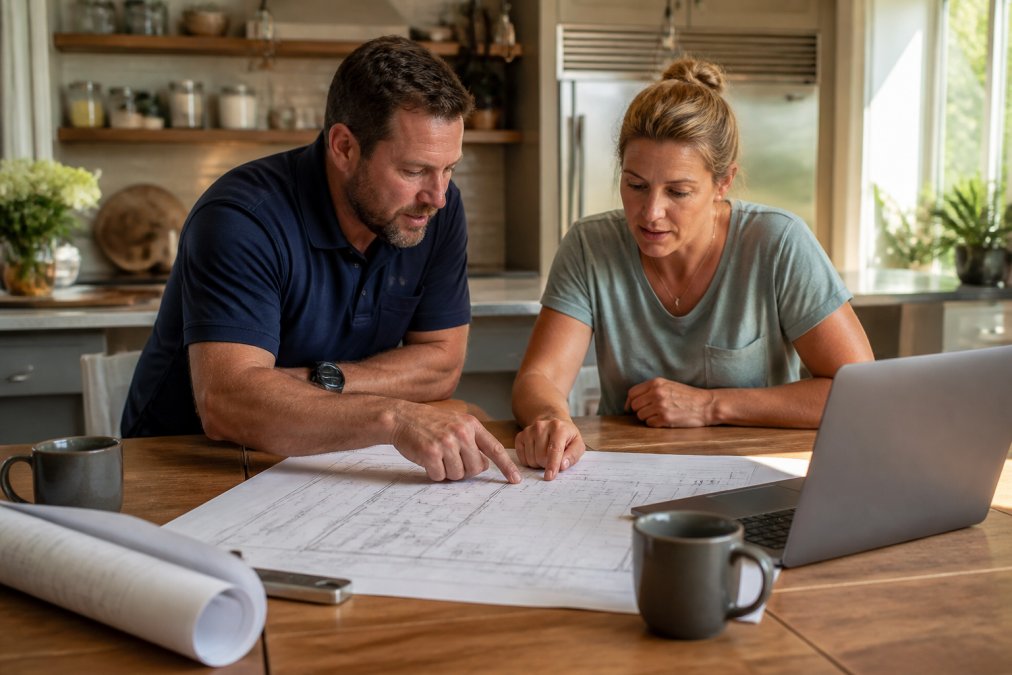
Set communication protocols on day one. That means a named point of contact, a response window for questions, and a shared channel where decisions get logged. When a subcontractor finds unexpected rot behind a wall, the homeowner should get a call that afternoon, not a change order three weeks later.
A common mistake is treating bad news as something to manage later. Delayed bad news compounds. Early bad news is just information.
Step 3: Use a General Contractor Meeting Agenda Template for Productive Check-Ins
A general contractor meeting agenda template turns a rambling site walk into a 20-minute decision session. Without one, check-ins drift into status updates that resolve nothing and leave both sides frustrated.
Use this structure for every weekly check-in:
| Agenda Item | Time | Purpose |
|---|---|---|
| Progress since last meeting | 5 min | Confirm completed milestones |
| Open RFIs and decisions needed | 5 min | Unblock the schedule |
| Change orders pending approval | 5 min | Keep budget adherence on track |
| Upcoming week and access needs | 5 min | Prevent site conflicts |
| Risks and site safety notes | 5 min | Flag issues early |
Send the agenda the day before. Ask the contractor to add items. A check-in where both sides shape the agenda produces stakeholder alignment instead of a one-way report.
Step 4: Master the Construction Change Order Process
The construction change order process is where good contractor relationships are either protected or destroyed. Every change, whether it comes from the homeowner, an inspector, or a hidden condition, should follow the same path.
A workable process looks like this:
- Document the change request in writing, with photos where relevant.
- Get a written cost and schedule impact before any work begins.
- Confirm whether the change affects permits or inspections.
- Approve or decline in writing, then log it against the contract.
- Update the project milestones and payment schedule to match.
Step 5: Learn How to Handle Contractor Disputes Without Litigation
Knowing how to handle contractor disputes without litigation saves both sides money and time. Most disagreements trace back to unclear documentation, not bad faith, which means most of them are preventable, and the ones that aren't preventable are usually resolvable long before anyone calls a lawyer.
The four-tier escalation ladder
A dispute framework only works if both parties agreed to it before the argument started. Build this ladder into the contract and reference it at kickoff:
- Direct resolution (24-72 hours). The two people closest to the issue talk it out, backed by the project record. No email chains, no copying the owner's attorney. Most field-level disagreements, a misaligned tile pattern, a missed rough-in, die here.
- Written notice and cure period. If direct talks fail, the aggrieved party issues written notice describing the specific breach and the cure window. Construction contracts commonly set cure periods between 7 and 30 days depending on the severity of the issue (americanbar.org). This step exists to create a paper trail, not to threaten.
- Mediation. A neutral third party, often retained through the American Arbitration Association or a local construction-focused mediator, facilitates a settlement. Mediation is typically non-binding, which is exactly why it works: neither side has to 'lose' to resolve the issue.
- Binding arbitration or litigation. The last resort. Most construction contracts include a binding arbitration clause to keep disputes out of court, but arbitration still costs real money and time. Treat this tier as a failure of tiers 1-3, not a strategy.
What the project record has to contain
A dispute framework is only as strong as the documentation behind it. Before any disagreement escalates, the file should already hold:
- The signed scope of work with line-item deliverables and exclusions.
- Every change order, signed and dated, with cost and schedule impact noted.
- Meeting minutes from each weekly check-in, distributed within 24 hours.
- Photo documentation of existing conditions and completed work at each milestone.
- Inspection reports and any correction notices from the authority having jurisdiction.
- A log of all written communications, including RFIs and their responses.
If any of those items are missing, the weaker-documented party usually loses the argument regardless of who was actually right.
Trade-specific flashpoints
Disputes cluster around predictable issues by trade. A few patterns worth pre-empting in the contract:
- Concealed conditions. Rot, asbestos, or out-of-code framing discovered after demolition. The contract should state who bears the cost of uncovering and remediating concealed conditions, and how the schedule adjusts.
- Finish tolerances. What counts as 'acceptable' for drywall seams, tile lippage, or paint sheen. Cite the applicable industry standard (for example, the Gypsum Association's GA-214 for drywall finish levels) rather than arguing about it after the fact.
- Back-charges. When one sub's delay forces another sub to remobilize, the back-charge mechanism should be defined in the subcontract, not improvised on the spot.
- Retainage release. The conditions for releasing retainage, punch list completion, final inspection sign-off, lien waivers, should be spelled out so the final payment isn't a surprise negotiation.
Where to get outside help
For public guidance on construction contract disputes and consumer protections, state licensing boards and the consumer protection resources from the Federal Trade Commission are useful starting points. For contract language and mediation logistics, the American Arbitration Association publishes construction-industry rules and mediator rosters. Read the dispute clause before the argument starts, not after, notice periods and cure rights are almost always time-barred if you miss the window.
The goal of a dispute framework isn't to win fights. It's to make sure the fights that do happen stay small, documented, and solvable without either side walking off the job.
Step 6: Use Construction Project Management Software for Real-Time Collaboration
Construction project management software replaces the group text chain with a single source of truth. But the tool itself is not the differentiator, every GC has access to the same platforms. What separates a well-run project from a chaotic one is the workflow discipline layered on top of the software: who logs what, where it lives, how fast it gets answered, and how the file structure holds up when a dispute or a warranty claim arrives two years later.
The features that actually matter for GC relationships
- Shared document access so architects, subs, and owners see the same drawings, with version control, so nobody builds off a superseded sheet.
- RFI tracking with timestamps, so response delays are visible to everyone and the schedule impact is documented automatically.
- Submittal logs tied to the procurement schedule, so long-lead items don't slip through.
- Photo documentation geotagged and tied to project milestones and inspections.
- Change order logs that connect directly to the payment schedule.
- Permission levels so subcontractors see only what concerns their scope, and owners see the summary view without drowning in trade-level detail.
RFI management: the workflow, not the button
An RFI tool is useless without a protocol. A workable standard for most residential and light commercial projects:
- Log every RFI in the shared platform, never in a text thread or a phone call. If it isn't logged, it didn't happen.
- Assign a response owner and a due date at the moment of creation. Common practice is a 48-hour response window for routine RFIs and 24 hours for anything on the critical path (Project Manager Development Program).
- Number RFIs sequentially and reference the drawing sheet, spec section, and photo where relevant.
- Close the loop in writing. The response becomes part of the project record and, if it changes scope or cost, triggers a change order.
- Review open RFIs at every weekly check-in. An RFI older than its due date is a schedule risk, not a paperwork problem.
File-sharing and documentation standards
Cloud-based documentation only works if everyone can find what they need without asking. A few conventions that pay off:
- One canonical folder per project, with subfolders for drawings, submittals, RFIs, change orders, photos, inspections, and closeout documents.
- A file-naming convention that includes the project number, discipline, sheet or document type, and revision (for example,
2026-014-MEP-RFI-007-R1). Ad-hoc names likefinal_final_v3.pdfare how superseded drawings end up on a job site. - Revision control on drawings. Only the current revision should be marked 'Issued for Construction.' Everything else gets archived, not deleted.
- Daily photo logs uploaded the same day, tagged by area and milestone. Retroactive photo dumps are worth far less in a dispute.
- Closeout package assembled as the project runs, not scrambled together at the end, warranties, O&M manuals, as-builts, lien waivers, and inspection sign-offs in one folder the owner can actually use.
Digital collaboration is still the exception
Digital collaboration workflows are still the exception in residential construction, which is exactly why they stand out. A contractor who shares a live project dashboard, answers RFIs inside a documented window, and hands over a clean closeout package signals professional reliability before a single invoice goes out, and gives the owner a reason to call back on the next project instead of re-bidding it.
Step 7: Maintain the Relationship After Project Completion
Post-project relationship maintenance is the step almost everyone skips, and it is where long-term partnerships are actually built. The punch list is closed, the final payment cleared, and then silence.
A simple follow-up cadence keeps the relationship warm:
- Check in 30 days after completion to confirm everything still performs as expected.
- Send warranty reminders before coverage windows close.
- Ask for a testimonial or referral while the project is still fresh.
- Reach out before the next seasonal maintenance window.
Repeat business and referrals are the cheapest work a general contractor can win, and they come from owners who felt looked after after the job ended, not just during it.
Managing a general contractor relationship is not about avoiding every disagreement. It is about building a project record strong enough that disagreements stay small, documented, and solvable. Master Builder llc. handles that work end to end, from initial planning through final execution, with a collaborative approach that keeps architects, designers, and owners aligned. Our team works efficiently on occupied and fully operational job sites, so your home or business keeps running while the work gets done. Get started with Master Builder llc. and book online to see what a seamless, well-documented build actually feels like.
Frequently Asked Questions
What are the signs of a bad general contractor relationship?
Warning signs include poor communication, missed deadlines without explanation, unexpected cost increases, and a contractor who avoids written documentation. If you find yourself constantly chasing updates or feeling dismissed, the relationship is deteriorating. Address issues early by scheduling a face-to-face meeting and requesting a written plan for improvement. If the contractor refuses to engage, it may be time to seek legal advice or terminate the contract according to its terms.
What is the best way to communicate project changes to a general contractor?
Always submit changes in writing through a formal change order request. Describe the change, reason, and desired outcome. Use construction project management software to log the request and track approvals. Follow up with a phone call or in-person conversation to ensure clarity. Never rely on verbal agreements; they lead to disputes. A written record protects both parties and keeps the project on track.
How do you resolve disputes with a general contractor without litigation?
Start by reviewing the contract's dispute resolution clause, which may require mediation or arbitration. Meet with the contractor to discuss the issue calmly, focusing on facts and the contract terms. If that fails, hire a neutral third-party mediator. Mediation is faster and cheaper than court. Many construction contracts include a step-by-step dispute process; follow it. Document everything, including emails and photos, to support your position if needed.
How often should you meet with your general contractor during a project?
Weekly meetings are standard for most residential and light commercial projects. For fast-paced or complex jobs, meet twice a week. Use a general contractor meeting agenda template to keep discussions focused on progress, budget, and upcoming tasks. Between meetings, rely on shared project management software for daily updates. Consistent communication prevents surprises and keeps the relationship strong.