
 how-to
Preventing Hidden Fees in Home Remodeling
Table of Contents
- Why Hidden Fees in Home Remodeling Are So Common
- Build a Home Renovation Contingency Budget Before You Break Ground
- Questions to Ask a General Contractor Before Hiring
- How a Remodeling Change Order Template Protects Your Budget
- Contractual Safeguards and Insurance Gaps That Cause Budget Overruns
- Digital Project Management Tools That Prevent Surprise Costs
- Post-Renovation Costs Most Homeowners Don't See Coming
- Preventing Hidden Remodeling Fees: A Step-by-Step Action Plan
Last Updated: August 23, 2026
Preventing hidden fees in home remodeling is one of the most common challenges homeowners face, and one of the most preventable. The Master Builder llc. team works with clients who have been burned before: a kitchen remodel quoted at one number that finished significantly higher, or a bathroom renovation that dragged on twice as long as promised. Those outcomes aren't inevitable. They're usually the result of missing a few key safeguards before the first nail goes in.
This guide walks you through exactly where hidden costs hide, how to structure your contracts and budget to stop them, and what tools experienced project managers use to keep remodels on track.
Why Hidden Fees in Home Remodeling Are So Common
Hidden fees in home remodeling are common because most cost estimates are built on assumptions. Contractors price what they can see. They cannot see what's inside your walls, under your floors, or buried in your crawl space, and that's where budgets go sideways.
Three categories account for the vast majority of unexpected costs.
Structural Issues Found After Demolition Starts
Demolition is the moment of truth. Once walls come down and floors come up, site inspections reveal conditions no one could have anticipated: rotted framing, water-damaged subfloor, undersized load-bearing members, or mold behind tile. These are genuinely invisible until work begins, and structural repairs must happen before anything else can proceed. They're not optional, and they're rarely cheap.
Permit, Zoning, and Code Compliance Costs
Building permits are legally required for most structural, electrical, plumbing, and HVAC work. According to U.S. Department of Housing and Urban Development guidance on residential permits, permit requirements vary significantly by jurisdiction, but skipping them creates serious liability, including forced demolition of unpermitted work.
Zoning regulations can restrict what you're allowed to build. Adding square footage, changing a roofline, or converting a garage may trigger zoning review, setback requirements, or variance applications. Code compliance upgrades, like bringing an older electrical panel up to current National Electrical Code standards, are often required before a permit will be issued.
Material Price Fluctuations and Long Lead Times
Material escalation is a persistent problem in residential construction. Lumber, copper pipe, and specialty fixtures shift in price between bid and procurement. Long lead times for custom cabinetry, windows, and HVAC equipment have stretched considerably in recent years, creating compounding costs: if your kitchen cabinets are delayed six weeks, your installer sits idle, your project timeline extends, and temporary accommodations multiply costs. Locking in material pricing early or building escalation language into your contract is the only reliable defense.
National Association of Home Builders resource on construction material costs
Build a Home Renovation Contingency Budget Before You Break Ground
A home renovation contingency budget is a dedicated reserve, typically 15% to 20% of your total project cost, held back specifically for unplanned expenses. This is standard professional practice.
Here's how to structure it properly:
- Get a fully itemized estimate first. Insist on line-item pricing: labor, materials, permits, subcontractor fees, disposal fees, and site preparation costs listed separately.
- Apply 15% on top of the itemized total. This is your contingency fund. Keep it liquid and separate from your primary renovation budget.
- Define what triggers a draw from contingency. Structural discoveries, code compliance upgrades, and utility upgrades are legitimate draws. A contractor's mistake is not.
- Track variance in real time. Every approved change order should be logged against your contingency balance.
- Resist the urge to spend unspent contingency mid-project. That money stays reserved until final inspection is complete.
| Budget Component | What It Covers | Why It Matters |
|---|---|---|
| Itemized base estimate | Labor, materials, permits, subs | Baseline for tracking variance |
| 15% contingency fund | Structural finds, code upgrades, escalation | Absorbs unplanned costs without derailing project |
| Temporary living expenses | Hotel, storage, meals during displacement | Often overlooked until too late |
| Post-renovation reserve | Maintenance, touch-ups, punch list items | Protects against quality issues after completion |
Questions to Ask a General Contractor Before Hiring
The biggest mistake homeowners make is treating the contractor interview as a formality. The questions you ask before signing determine whether you're protected when things get complicated.
Ask these before you commit:
- Are you licensed and insured in this state? Verify it independently.
- Who pulls the permits, and how are permit fees handled? Some contractors pass permit costs through at cost; others mark them up.
- How do you handle subcontractor fees? Are subs billed at cost, or is there a markup?
- What is your process when demolition reveals unexpected structural issues? A contractor without a clear answer hasn't thought it through.
- What is your payment schedule? Never pay more than 10% upfront. Progress payments tied to completed milestones are standard.
- How do you communicate during the project? Daily updates, weekly summaries, or only when there's a problem?
- Can I see a sample change order form? If they don't have one, that's a red flag.
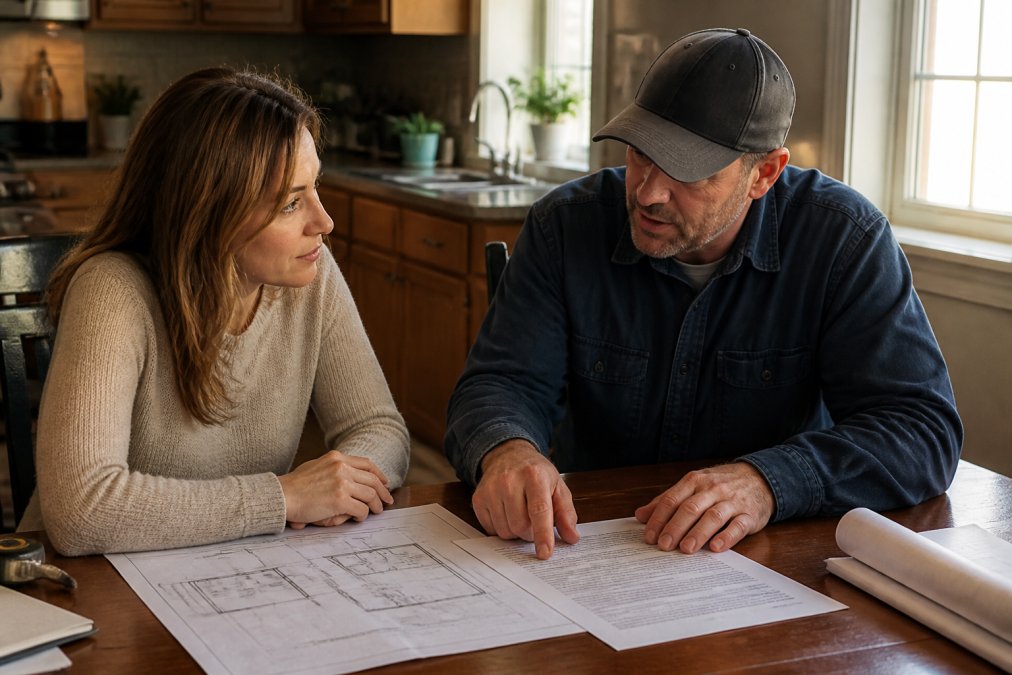
Contract Type: Fixed-Price vs. Cost-Plus vs. Time and Materials
The contract type you sign shapes your entire financial exposure.
Fixed-price contract: You agree to a set total. The contractor absorbs cost overruns but prices in a risk premium upfront. Best for well-defined scopes where architectural drawings are complete before work begins.
Cost-plus contract: You pay actual costs plus a contractor fee (flat or percentage). Transparent, but your final cost is open-ended. Best for complex or phased projects where the full scope can't be defined upfront.
Time and materials: You pay hourly labor plus material costs. Maximum flexibility, maximum financial risk. Appropriate only for very small or exploratory work.
For most residential remodels, a fixed-price contract with a clearly defined change order process offers the best protection.
How a Remodeling Change Order Template Protects Your Budget
A remodeling change order template is a written document that formally records every modification to the original project scope, including cost impact, timeline impact, and required signatures before any new work begins. Without one, verbal agreements about scope changes become disputes after the fact.

A complete change order template should include:
- Description of the scope change (specific and detailed)
- Reason for the change (structural discovery, client request, code requirement)
- Cost impact: additional labor, materials, and subcontractor fees
- Timeline impact: how many days the change adds to the renovation timeline
- Updated project total after this change order
- Running contingency fund balance
- Contractor signature and date
- Homeowner signature and date
- Reference number tied to the original contract
No work should proceed on a change before both parties sign. This single rule prevents the majority of post-project billing disputes.
Contractual Safeguards and Insurance Gaps That Cause Budget Overruns
Most homeowners review the price in a contract. Few read the liability provisions, and that's where the real risk lives.
Your contractor must carry general liability insurance and workers' compensation coverage. Ask for certificates of insurance naming you as an additional insured. If an uninsured worker is injured on your property, your homeowner's insurance may be your only line of defense.
Understand the lien waiver process. Subcontractors and material suppliers who aren't paid by your general contractor can file a mechanic's lien against your property, even if you paid your contractor in full. A lien waiver, collected from each sub and supplier upon payment, releases that right. According to American Bar Association guidance on mechanic's liens, mechanic's lien laws vary by state but are enforceable in all 50 states and can cloud your title for years if not resolved.
Digital Project Management Tools That Prevent Surprise Costs
The most common reason homeowners lose track of their renovation budget isn't fraud, it's poor documentation. Verbal approvals, informal texts, and handshake agreements create gaps that cost money when memories diverge.
Digital project management tools solve this by creating a single, timestamped record of every decision, approval, and cost change. For homeowners managing a remodel, the minimum useful setup includes:
- A shared project tracker where your contractor logs daily progress, material deliveries, and subcontractor schedules.
- A change order log updated in real time whenever scope changes are approved.
- A document folder holding signed contracts, permit applications, inspection reports, and certificates of insurance.
- A payment schedule tracker showing what has been paid, what is due, and what milestones must be completed before the next payment releases.
At Master Builder llc., our end-to-end project management approach means clients aren't left coordinating between architects, subcontractors, and inspectors on their own. That coordination gap is one of the most common sources of hidden costs and timeline delays.
Post-Renovation Costs Most Homeowners Don't See Coming
The final inspection isn't the end of the financial story. Post-renovation costs catch many homeowners off guard because they're not part of the original project scope, but they're real and often significant.
The most common ones include punch list repairs, touch-up painting and finish work, HVAC system balancing, plumbing rough-ins and fixture adjustments, appliance and system commissioning, landscaping and exterior restoration, and utility connection fees. A realistic post-renovation reserve of 3% to 5% of your total project cost covers most of these without stress.
Preventing Hidden Remodeling Fees: A Step-by-Step Action Plan
Preventing hidden fees in home remodeling comes down to preparation, documentation, and asking the right questions before work begins.
Here is the complete action plan:
- Get three fully itemized bids. Compare line by line, not just total price.
- Verify licenses and insurance independently. Check your state contractor licensing board and request current certificates of insurance.
- Choose the right contract type for your project scope. Fixed-price for well-defined work; cost-plus for complex or phased projects.
- Negotiate a clear change order process into the contract. Every scope change requires a signed change order before work proceeds.
- Build a 15% contingency fund and keep it separate. Track every draw against it in real time.
- Budget for permit and code compliance costs upfront. Ask your contractor to estimate permit fees and likely code upgrade requirements before you sign.
- Set up a digital project management system with shared access for you and your contractor.
- Collect lien waivers from subcontractors and suppliers at each payment milestone.
- Budget a post-renovation reserve of 3% to 5% for punch list items, touch-ups, and system adjustments.
- Schedule a final walkthrough before releasing the last payment. The final payment is your last point of leverage.
Preventing hidden fees in home remodeling isn't about distrusting your contractor. It's about building a project structure where surprises have a designated place to land and can't derail your budget. The homeowners who finish remodels on budget are almost always the ones who did this work upfront.
For additional guidance on residential construction contracts, the Federal Trade Commission's consumer guidance on home improvement contracts outlines the rights homeowners have and the terms that should appear in any legitimate agreement.
Hidden costs don't have to define your remodel. The right contractor partnership, one with transparent pricing, a structured change order process, and genuine end-to-end project management, eliminates most of the surprises before they start. Master Builder llc. brings exactly that approach to every project: comprehensive planning and staffing, collaborative coordination with architects and designers, and the ability to work on occupied job sites without shutting your life down. Book online with Master Builder llc. and start your project with a team that manages the complexity so you don't have to.
Frequently Asked Questions
What are the most common hidden costs in home remodeling?
The most common hidden fees in home remodeling include structural repairs uncovered during demolition, building permit and inspection fees, code compliance upgrades to electrical panels or plumbing rough-ins, HVAC retrofitting, and debris disposal fees. Material price escalation after a contract is signed also catches homeowners off guard. A 15% contingency fund on top of your base budget is the standard safeguard against these surprises.
What is a reasonable contingency budget for a home renovation?
Most construction professionals recommend setting aside 10% to 20% of your total project budget as a contingency fund, with 15% being the widely cited standard. Older homes, gut renovations, and projects involving structural work warrant the higher end. This reserve covers unexpected costs like outdated wiring, hidden water damage, or mid-project change orders without forcing you to pause or cut scope.
How do change orders affect the final price of a remodel?
Change orders are written amendments that adjust the project scope, cost, or schedule after the original contract is signed. Without a formal remodeling change order template, verbal approvals can lead to disputed invoices and significant budget overruns. Every change order should state the description of work, cost impact, and schedule impact before any new work begins. Reviewing and signing each one keeps your final price predictable.
Do permits and inspections count as hidden remodeling costs?
They often do, because many initial quotes exclude permit fees, zoning application costs, and required site inspections. Building permit costs vary by project type and local jurisdiction. Ask your general contractor to itemize permit and inspection fees in the original estimate. Skipping permits to save money risks fines, failed appraisals, and costly remediation work if the project is flagged during a future home sale.
This article was written using GrandRanker