 listicle
Best Materials for Long-Lasting Home Exteriors
Table of Contents
- What Makes an Exterior Material Long-Lasting
- Fiber Cement vs Vinyl Siding: Durability and Performance
- Siding Lifespan by Material: What to Expect
- Low-Maintenance Exterior Siding Options
- Weather-Resistant Siding Options for Extreme Climates
- Installation Quality and Long-Term Performance
- Choosing the Right Material for Your Home
- Frequently Asked Questions
Last Updated: October 17, 2026
What Makes an Exterior Material Long-Lasting
Durability isn't just about avoiding replacement costs, it's about protecting your investment for decades. The best materials for long-lasting home exteriors combine weather resistance, structural integrity, and minimal maintenance.
What separates a 20-year exterior from a 50-year one? Three factors: moisture resistance, how the material handles temperature swings, and whether installation quality holds up. The right choice means the difference between a home that ages gracefully and one that deteriorates rapidly.
Most homeowners focus only on upfront cost, but that's backwards. A material that costs less initially but needs replacement in 15 years drains your budget far more than a premium option lasting 40. This guide breaks down which materials actually deliver long-lasting home exteriors, and which only appear to.
Fiber Cement vs Vinyl Siding: Durability and Performance
Fiber cement and vinyl represent two opposite approaches to exterior durability. Understanding the trade-offs between them shapes most exterior decisions.
Fiber cement siding combines Portland cement, sand, and cellulose fibers into boards that resist rot, pests, and fire.
Vinyl siding costs less upfront and requires virtually no maintenance, it won't rot or attract termites. But it becomes brittle in cold and can warp in extreme heat. High-quality vinyl lasts 15-20 years; lower grades fail sooner.
Most guides treat durability as only about lifespan. Fiber cement lasts longer but demands regular painting and caulk maintenance; vinyl lasts shorter but needs almost nothing.
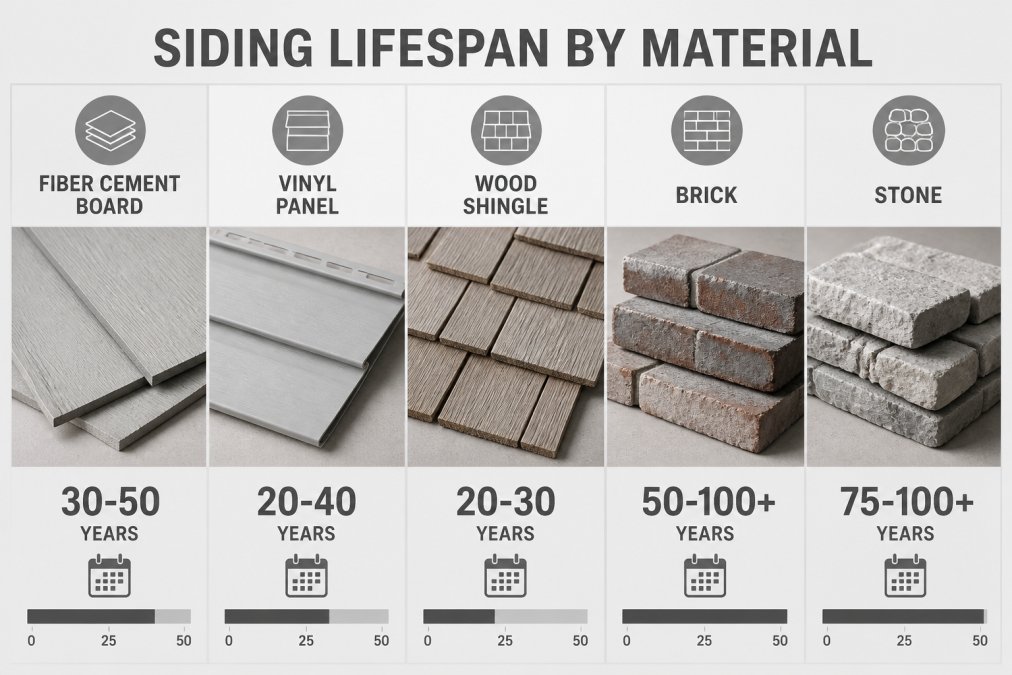
Siding Lifespan by Material: What to Expect
Lifespan numbers get thrown around loosely. The ranges below reflect professional experience and manufacturer warranties, treat them as planning estimates, not guarantees. Real service life depends on climate, installation quality, and maintenance. Where possible, we note maintenance and replacement costs so you can compare lifecycle cost, not just lifespan.
Wood and Engineered Wood
Real wood siding has authentic character no substitute matches, and real vulnerabilities. Unprotected solid wood deteriorates in 5-10 years; with repainting every 7-10 years, it can last 20-40 years.
Engineered wood (such as LP SmartSide) resists moisture better than solid wood but still needs regular maintenance, expect 15-25 years with committed upkeep. Both require professional installation and consistent care; one missed paint cycle lets moisture penetrate the substrate. Deferred maintenance can turn a 40-year material into a 10-year liability.
Lifecycle cost snapshot: A typical wood-sided home might spend $3,000-$6,000 per repaint cycle (depending on home size and region), plus spot repairs. Over 30 years, that's $9,000-$18,000 in maintenance alone, before any replacement.
Brick and Masonry
Brick is exceptional for longevity, a well-built wall can last 100+ years. It doesn't rot, won't burn, and resists pests completely. The real vulnerability is the mortar, which typically needs repointing every 20-40 years.
Repointing is skilled, labor-intensive work, commonly $3-$10 per square foot, so a 2,000-square-foot exterior could run $6,000-$20,000 per cycle. But the material itself is nearly permanent, making brick compelling if you plan to stay for decades.
Warranty caveat: Brick itself rarely carries a meaningful warranty; workmanship and mortar are the weak links. Ask about the mason's warranty on flashing and weep holes, those details determine whether the wall performs for 100 years or 30.
Natural Stone and Stone Veneer
Natural stone (granite, limestone, slate) outlasts almost everything, 100+ years with minimal intervention. It doesn't weather or degrade like other materials; it actually gets harder as it ages.
Stone veneer (thin-cut stone adhered to a substrate) reliably lasts 20-30 years, sometimes longer. The limitation isn't the stone but the adhesive and backing system, so installation quality matters enormously. Manufactured veneer warranties often run 30-50 years on the product, but exclusions for installation and moisture intrusion are common.
Lifecycle cost snapshot: Full-bed stone is expensive upfront (often $15-$30+ per square foot installed), but with near-zero maintenance, its 50-year cost can rival mid-range materials. Veneer is cheaper upfront but may need substrate repairs within 25 years.
Metal Siding
Steel and aluminum siding can last 40-60 years when properly maintained. Steel is stronger but rusts if the protective coating fails; aluminum won't rust but dents easily and corrodes in coastal environments.
Metal requires virtually no maintenance, but damage is hard to repair, a dent or rust spot usually means replacing a large section. Paint finishes often carry 20-30 year warranties, though chalking and fading still occur.
Lifecycle cost snapshot: Minimal maintenance costs (occasional cleaning, spot painting), but replacement of damaged panels can be $500-$1,500 per section depending on accessibility and matching availability.
Stucco and Traditional Finishes
Stucco is a cement-based coating that can last 50-80 years, but its lifespan depends almost entirely on the substrate and flashing underneath. Stucco fails not because it cracks, but because water penetrates behind it through inadequate flashing or poor installation.
Warranty caveat: Stucco warranties frequently exclude water intrusion claims, placing the burden on the installer's flashing work. Ask for details on weep screeds, control joints, and drainage planes.
Low-Maintenance Exterior Siding Options
For long-lasting home exteriors without constant upkeep, some materials deliver that trade-off better than others.
Vinyl siding requires almost no maintenance, no rot, no painting, pest-resistant. Hose it down occasionally and you're done.
Fiber cement is the middle ground: repaint every 7-10 years, but no caulk replacement, pest issues, or rot concerns between paint cycles.
Brick and stone require almost zero maintenance once installed, the only ongoing task is repointing brick mortar every 20-40 years, significant but infrequent.
The real insight: low-maintenance doesn't mean longest-lasting. Vinyl is low-maintenance but shorter-lived; brick is both, but upfront cost and repointing expense deter many homeowners.
Weather-Resistant Siding Options for Extreme Climates
Different climates punish different materials, and choosing right for your climate prevents premature failure. Below we break down performance by specific hazard, not broad climate labels, so you can match material to the stresses your home actually faces.
Freeze-Thaw Cycles
In cold climates, absorbed water expands when it freezes, cracking materials from the inside. Fiber cement, metal, and brick handle freeze-thaw well, resisting water absorption or accommodating expansion. Vinyl becomes brittle and can crack under impact. Wood and stucco are vulnerable unless extremely well-maintained, any gap in paint or sealant lets water in, and freeze-thaw does the rest.
Actionable tip: In freeze-thaw regions, prioritize materials with low water absorption and details that shed water quickly, proper flashing, weep holes, and back-ventilated rainscreens.
Coastal Salt Exposure
Salt spray corrodes unprotected metal and degrades mortar. Stone and brick handle salt better than most materials, though mortar repointing becomes more frequent. Vinyl works well in coastal areas because salt doesn't degrade it, but wind-driven rain can penetrate poor installations. Aluminum siding corrodes in coastal environments; steel requires factory-applied coatings and regular rinsing to resist rust.
Actionable tip: Within a mile of the coast, avoid uncoated steel and specify corrosion-resistant fasteners. Rinse exterior surfaces periodically to remove salt buildup.
Wildfire Risk
In wildfire-prone areas, material combustibility matters. Brick, stone, stucco, and fiber cement are noncombustible or limited-combustible and perform well. Wood and engineered wood are combustible and can ignite from embers. Vinyl can melt and contribute to fire spread. Metal siding is noncombustible but conducts heat.
Actionable tip: In high wildfire risk zones, prioritize noncombustible materials and pay equal attention to vents, eaves, and decking, the weakest link often isn't the siding itself.
Hail and Impact
Hail damages materials differently. Fiber cement resists hail well but can crack under extreme impact. Vinyl can crack or puncture, especially in cold weather. Metal can dent. Brick and stone resist hail best. Wood can splinter.
Actionable tip: In hail-prone regions, choose fiber cement or masonry and verify impact ratings where available.
High Winds
Wind-driven rain and uplift are the concerns. Properly fastened fiber cement and metal panels perform well when installed to code. Vinyl can detach in high winds if not locked properly. Brick and stone are heavy and resist wind but require secure ties to the structure.
Actionable tip: In hurricane or high-wind zones, confirm fastening schedules and product approvals for your wind zone.
Humidity and Moisture
In humid climates, moisture penetration is the primary threat. Fiber cement, brick, and metal outperform vinyl and wood here. These materials resist water absorption and don't rot. Vinyl can work in humid climates if installed with proper drainage behind it, but poor installation leads to trapped moisture and failure.
Actionable tip: In humid regions, prioritize drainage planes and ventilation behind the siding, regardless of material.
Installation Quality and Long-Term Performance
Here's what most homeowners don't realize: the best material installed poorly fails faster than a mediocre material installed right.
Proper flashing is where most installations fail. Water finds every gap and crack.
Vapor barriers matter too. Some materials need ventilation behind them to allow moisture to escape. Others need sealed barriers to prevent moisture penetration. Mismatching the material to its required substrate system guarantees problems.
Caulking and sealants are maintenance items, not installation items, but they're critical. Gaps between materials expand and contract with temperature. Properly sealed gaps stay watertight. Unsealed or poorly sealed gaps let water in.
Poor installation isn't just a cosmetic problem; it's the reason homeowners replace exteriors years early.
Choosing the Right Material for Your Home
The best materials for long-lasting home exteriors depend on your specific situation, not on universal rules.
Start with your climate. A material that thrives in one region fails in another. Then consider your maintenance tolerance.
Budget matters, but think in lifecycle terms, not purchase price. A material costing 40% more upfront but lasting twice as long is actually cheaper over time.
Quality installation matters more than material choice. The best material installed poorly fails. A good material installed right lasts decades.
We recommend consulting with professionals who understand both your climate and your specific home. A general contractor experienced in your region knows which materials perform best and which fail predictably.
Choosing the right materials for your home's exterior is one of the most important decisions you'll make as a homeowner.
Frequently Asked Questions
What is the most durable material for a home exterior?
Brick masonry and natural stone are among the most durable exterior materials, often lasting 100+ years with minimal degradation. Fiber cement siding ranks second, with typical lifespans of 25-40 years and superior resistance to rot, pests, and weather damage compared to vinyl. The best choice depends on your climate, budget, and maintenance tolerance. Brick requires virtually no maintenance but costs more upfront; fiber cement offers a balance of durability and affordability.
Is fiber cement or vinyl siding more durable?
Fiber cement siding is significantly more durable than vinyl. Fiber cement typically lasts 25-40 years and resists rot, termites, hail, and impact damage that can crack or puncture vinyl. Vinyl siding lasts 20-40 years but is more prone to warping in extreme heat, brittleness in cold, and damage from storms.
Which siding material requires the least maintenance?
Vinyl siding and fiber cement require minimal maintenance compared to wood. Both resist rot and pest damage naturally and need only occasional cleaning with a hose or mild detergent. Brick and stone require virtually no maintenance beyond periodic repointing of mortar joints. Wood siding demands regular painting or staining every 5-7 years and inspection for rot and insect damage. If low maintenance is your priority, vinyl or fiber cement offer the best balance of durability and ease.
How long does wood siding last?
High-quality wood siding lasts 20-40 years with proper maintenance; engineered wood typically lasts 15-20 years. Longevity depends heavily on climate, paint condition, and preventive care. Wood exposed to moisture, extreme temperature swings, or pest pressure deteriorates faster. Regular painting or staining every 5-7 years, prompt repair of damage, and proper drainage extend lifespan significantly. In dry climates with diligent maintenance, wood can reach 40+ years. In humid or wet climates, expect 20-25 years even with care.