 How-to
How Do You Prevent Water Damage to Your Foundation?
Quick Summary
Preventing foundation water damage starts with keeping rain away from the house. Slope the soil so it falls at least 10 feet away from the foundation, and extend downspouts so water lands well clear of the walls. If the damp persists, identify the water source before choosing a fix, because roof runoff, grading, plumbing leaks, and groundwater each need a different remedy.
- Aim for a noticeable slope away from the house for at least 10 feet.
- Extend downspouts so water lands well away from the wall, or run them to a splash block.
- Clean gutters once or twice a year so they do not overflow.
- Do not pile soil against siding or wood trim, because it traps moisture and invites rot.
- Water that discharges within two or three feet of the wall points to a short downspout extension.
Table of Contents
- How Do You Prevent Water Damage to Your Foundation?
- How Water Damages a Residential Foundation
- Signs of Water Damage to Foundation Walls and Floors
- How to Divert Water Away From House Foundation
- Installing a French Drain Around Your House
- Diagnosing the Source of Water Around Your Foundation
- Foundation-Specific Guidance for Slab, Crawl Space, and Basement Homes
- Booking a Foundation Drainage Assessment With Master Builder
- Frequently Asked Questions
How Do You Prevent Water Damage to Your Foundation?
Last Updated: November 10, 2026
Water is the most common threat to a house foundation, and foundation water damage is among the costliest problems a homeowner can face.
This guide shows you how to spot the problem early, direct water away from your home, and know when to call a professional. Preventing foundation water damage is generally less costly than repairing it.
How Water Damages a Residential Foundation
Water damages a foundation when it soaks into the surrounding soil and pushes against the walls. Over time, that pressure causes cracks, bowing, and leaks.
Here is how it usually happens:
- Rain runs off the roof and lands next to the house
- Water pools in low spots near the foundation
- Soil stays wet, swells, and presses against the walls
Keep this in mind: the soil near your house matters more than the foundation itself. Ground that slopes toward the house sends water straight to the walls.
Signs of Water Damage to Foundation Walls and Floors
Look for these warning signs, especially after heavy rain:
- Hairline or stair-step cracks in brick or block walls
- Damp spots, efflorescence (white powder), or musty smells in a basement
- Doors and windows that stick for no clear reason
If you see any of these, check the grading and downspouts first. Those are the cheapest fixes and often the cause.
How to Divert Water Away From House Foundation
The goal is simple: every drop of rain that hits your roof or yard should end up at least several feet from the house. Two steps do most of the work.
Regrading Soil to Slope Away From the House
Grading is the slope of the soil around your home. The ground should drop away from the foundation.
- Aim for a noticeable slope away from the house for at least 10 feet
- Add soil where the ground has settled, and tamp it down as you go
Watch out: do not pile soil against siding or wood trim, because it traps moisture and invites rot.
Extending Downspouts and Gutter Runoff
Downspouts that dump water at the base of the wall are a common cause of foundation problems. Extend them so water lands well away from the house.
- Use extensions long enough to carry water well away from the wall, or run them to a splash block
- Clean gutters once or twice a year so they do not overflow
- Make sure water flows away from the wall, not toward it
Installing a French Drain Around Your House
A French drain is a trench filled with gravel and a perforated pipe that collects groundwater and carries it away.
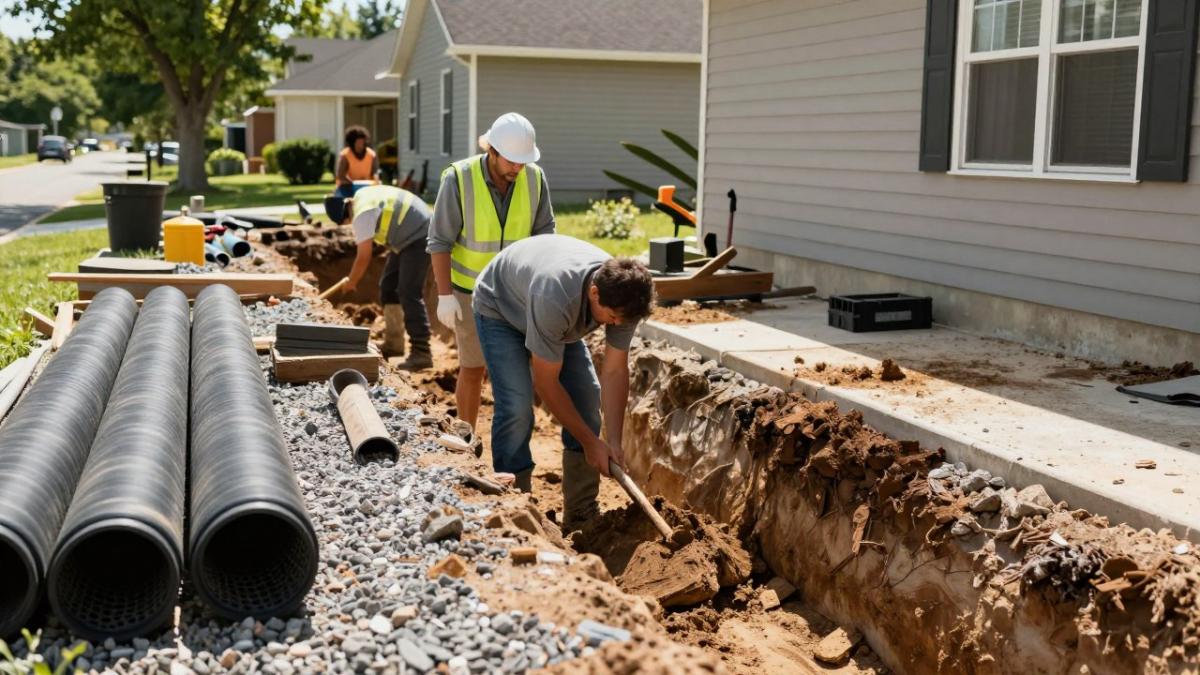
A basic French drain includes:
- A trench sloped away from the house
- Perforated pipe set in gravel
- Landscape fabric to keep soil out of the gravel
!Contractor crew digging a shallow trench beside a home, with gravel and perforated pipe staged nearby
Installing a drain that outlets close to the house, or onto a neighbor's property, can create new problems, so check local rules before digging.
Diagnosing the Source of Water Around Your Foundation
Before you regrade or buy a downspout extension, identify where the water is actually coming from. The same damp spot can have five different sources, each needing a different fix, and fixing the wrong one wastes money.
Work through the sources below in order, testing each before moving on. Most checks take under an hour and need only a garden hose, a flashlight, and a helper.
Step 1: Roof Runoff
Roof water is the most common culprit and the easiest to confirm. During or right after a steady rain, go outside and watch the gutters and downspouts.
- Overflowing gutters or water streaming over the edge at a single point usually means a clogged section or an undersized gutter.
- Water that discharges within two or three feet of the foundation wall points to a short or missing downspout extension.
- Staining or peeling paint on the lower siding below a gutter joint often marks a leaking seam.
If the wall stays dry during rain but gets wet only after the gutters have been running for a while, the roof is still a suspect, because the water may be reaching the wall through a long, poorly directed path.
Step 2: Surface Grading
Grading problems show up as water that moves across the yard and settles against the house. Water a patch of soil next to the foundation for ten minutes and watch where it goes.
Watch out: do not conclude that grading is fine just because the soil looks sloped. Settlement over the years often leaves a flat zone close to the wall that a casual glance will miss.
Step 3: Plumbing Leaks
Plumbing leaks produce water that appears even on dry days, and they often have a specific location. Check for these signs:
- A damp patch on the wall or floor that stays wet between rainstorms.
- A water meter that keeps moving when all fixtures are off. Read the meter, wait two hours with no water in use, and read it again.
- Soft or discolored flooring above a basement or crawl space near a bathroom, kitchen, or laundry line.
If the wetness persists in dry weather and the meter moves, call a plumber before assuming the problem is outside.
Step 4: Groundwater
Groundwater is the hardest source to confirm and the most likely to return after a surface fix. It usually shows up as seepage through the lower basement wall or floor joint, often after long wet seasons.
A practical test is to watch for water that keeps appearing at the same spot after several dry days.
Step 5: Surface Drainage and Low Spots
A distinct problem is the low spot in the yard that collects water from a wide area and holds it against the foundation. This water does not come from the roof and is not a plumbing or groundwater issue; it is runoff from neighboring lots or from paved areas such as driveways and patios that slope toward the house.
Matching the Fix to the Source
Once you know the source, the remedy follows directly. Roof runoff is solved with gutters and downspout extensions. Grading problems are solved by adding soil and reslope. Plumbing leaks need a plumber. Groundwater usually requires a perimeter or French drain.
Before fixing anything, the article lists five possible water sources and the test that identifies each.
| Source | How to confirm | Matching fix |
|---|---|---|
| Roof runoff | Water discharges within 2-3 feet of the wall | Gutters and downspout extensions |
| Surface grading | Water flows back toward the wall | Add soil and reslope |
| Plumbing leaks | Wet in dry weather; meter moves with no fixtures on | Call a plumber |
| Groundwater | Dampness appears days or weeks after rain | Perimeter or French drain |
| Surface low spots | Water gathers from wide area during storms | Swale or regraded path to safe outlet |
Foundation-Specific Guidance for Slab, Crawl Space, and Basement Homes
The same water problem behaves differently depending on how the house is built, and a fix that protects one foundation type can harm another. Identify your type first: a slab sits directly on the ground, a crawl space has a shallow void of roughly two to four feet, and a basement is a full level below grade.
Slab Foundations
In a slab home, water reaches the concrete from below and from the edges. Moisture can wick up through the slab, and perimeter water can seep into the joint where slab meets wall or into cracks.
- Keep grading sloped away from the perimeter, paying particular attention to the first few feet where the slab edge meets the soil.
- Keep irrigation heads and water features at least several feet from the edge so that the soil beside the slab does not stay saturated.
- Look for hairline cracks in the slab and the joint at the wall. Cracks that widen or let water in should be evaluated, because a slab can settle unevenly when the soil under it is repeatedly wetted and dried.
Watch out: do not dig a trench right against a slab edge to install a drain without first confirming the depth of the footing and any buried utilities.
Crawl Space Foundations
Crawl spaces collect moisture from the soil and from humid outside air, which can then condense on cold framing and ductwork. The priority is controlling what enters the space and how it dries.
- Keep foundation vents clear of soil, mulch, and debris, and check that vent openings are not blocked by plants or snow.
- Cover the exposed soil with a continuous vapor barrier, sealed at the seams and turned up the walls. A barrier reduces moisture rising from the ground, though it does not stop water entering from the outside.
- Check the sump or drainage points if the space has one, and confirm that water is not standing on the barrier after rain.
Watch out: sealing vents completely to reduce humidity can trap moisture inside and encourage rot, so balance air sealing with the airflow the space needs.
Basement Foundations
Basements take the greatest hydrostatic pressure, since the walls retain saturated soil. Water crossing the wall tends to appear at the bottom of the wall, at the cove joint where wall meets floor, and at window wells and cracks.
- Outside grading and roof drainage remain the first line of defense, because a basement wall cannot be kept dry for long if the soil against it stays saturated.
- A perimeter drain at the footing level, with a sump pump where gravity outlet is not possible, relieves pressure on the wall. Confirm that the discharge is far enough from the house that the water does not return to it.
- Interior sealants and waterproof coatings can slow seepage through the wall or floor, but they treat the symptom. They should be used alongside exterior control, not as a substitute for it.
Watch out: do not seal visible interior cracks and assume the problem is solved. A crack leaking under pressure may just move the water to another point while the wall deteriorates behind the coating.
When the Foundation Type Changes the Decision
If you are unsure which approach fits, ask where the water enters relative to the lowest occupied or structural level. Exterior grading and downspout control help all three types, footing drainage and vapor control matter most for basements and crawl spaces, and slab homes depend on keeping the perimeter dry. Bring in a professional for any repair involving excavation against a footing, under a slab, or through a basement wall.
Booking a Foundation Drainage Assessment With Master Builder
If the signs above are showing up, or if grading and downspout fixes did not solve the problem, it is time for a professional look. You can book online to have the source of your water problem identified before any digging starts.
Water problems rarely fix themselves, and small leaks grow into costly foundation repairs. Master Builder llc. can assess your drainage, plan the right fix, and handle the work from start to finish. Get started by booking online today.
Frequently Asked Questions
How can I protect my house foundation from water damage?
Start with the sources you can control: grade the soil so it slopes at least 6 inches over the first 10 feet away from the house, extend downspouts so roof runoff discharges well beyond the foundation, and clean gutters at least once or twice a year. Check for pooling after heavy rain, since standing water near the wall is an early sign that the grading or drainage needs work. If these measures do not stop the water, a French drain or a professional drainage assessment is the next step.
Do French drains help protect a home's foundation?
Yes. A French drain is a gravel-filled trench with a perforated pipe that collects groundwater and surface water before it reaches the foundation and carries it to a safe outlet. It is most useful where the soil drains poorly or the lot slopes toward the house. Its effectiveness depends on correct depth, a continuous slope to the outlet, and a clear discharge point, so a poorly installed drain can concentrate water rather than remove it.
How can I tell if water is damaging my foundation?
Look for horizontal or stair-step cracks in block or poured walls, damp or efflorescent (white, powdery) patches on the walls, bowed or leaning walls, doors and windows that begin sticking, and musty odors in a basement or crawl space. Water staining along the base of the wall after rain is also a strong indicator. Any of these signs warrants a professional inspection, particularly if they appear after a wet season.
Does homeowners insurance cover foundation damage due to water?
It depends on the policy and the cause. Standard homeowners policies generally cover sudden water damage, such as a burst pipe, but often exclude gradual seepage, poor drainage, and flood damage, which usually requires a separate flood policy. Review your policy's exclusions and ask your agent specifically about foundation and groundwater coverage. Keeping records of maintenance such as grading and gutter cleaning can also help if a claim is disputed.