
 how-to
5 Steps to Verify a General Contractor License
Table of Contents
- Why Verifying a Contractor License Matters
- Step 1: Locate the Contractor License Number
- Step 2: Verify Contractor License by Name on the Licensing Board Website
- Step 3: Check Contractor License Status and Expiration Date
- Step 4: Review Disciplinary Actions and Complaints
- Step 5: Confirm Insurance, Bonding, and Credentials
- Create Your Contractor License Verification Checklist
- What to Do If License Information Doesn't Match
- Frequently Asked Questions
Last Updated: October 5, 2026
Why Verifying a Contractor License Matters
Hiring a general contractor is one of the biggest decisions you'll make for your home or business. Before you sign anything, follow 5 steps to verify a general contractor license and ensure they have a clean record.
Understanding 5 steps to verify a general contractor license, starting with the license number, proves they're legally allowed to do the work. It means they've passed exams, met insurance requirements, and submitted to regulatory oversight.
Most people assume a contractor's word is enough and skip verification. Six months into a project, they discover the contractor was never licensed, their license expired, or they have unresolved complaints. By then, you're stuck with work that wasn't done to code and no legal recourse.
Step 1: Locate the Contractor License Number
Ask the contractor directly. A legitimate contractor will provide it without hesitation. If they seem evasive, that's a red flag.
Look for it on their business card, website, quote, vehicle signage, or email signature. Write down the full license number and the state where it was issued.
Step 2: Verify Contractor License by Name on the Licensing Board Website
Now that you have the license number, it's time to check it against the official state records. This is where you find out if the license is real and currently active.
Finding the Right State Portal
Search for "[Your State] contractor license verification" in Google and look for the official state government website (URL containing ".gov"). Find the "License Lookup" or "Verify a License" section, usually on the homepage.
Navigating the Verification Portal
Enter the license number in the search box. If valid, the contractor's full information appears: name, business name, license type, issue date, and expiration date. If no results, search by name instead.
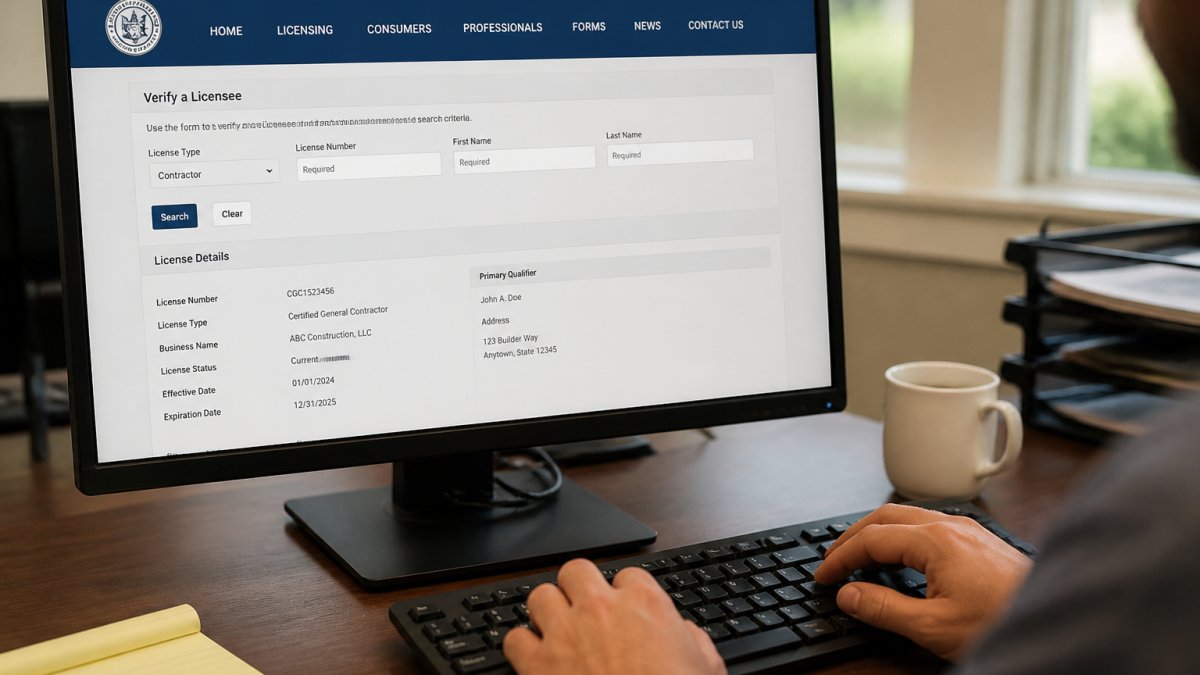
Verify that the license type matches the work quoted, the business name matches, and the status shows "Active" or "Current." If nothing comes up, the license is invalid.
Step 3: Check Contractor License Status and Expiration Date
Check the expiration date. If it expires during your project timeline, the contractor cannot legally work. Ask when they plan to renew and get confirmation in writing. If they seem uncertain, that's a warning sign.
Step 4: Review Disciplinary Actions and Complaints
This is where you find out if the contractor has a history of problems. Most state licensing boards maintain public records of complaints, investigations, and disciplinary actions. This step separates contractors with isolated incidents from those with patterns of serious violations.
Locating Complaint Records on Your State Portal
Return to the licensing board website and look for "Complaint History," "Disciplinary Actions," or "Public Records." Enter the contractor's license number or name to view open complaints, closed complaints, disciplinary actions, and current license status. If the portal is unclear, call the licensing board directly.
Understanding Complaint Severity and Status
Distinguish between complaint types: Open complaints indicate ongoing investigations; closed complaints may be resolved or upheld with disciplinary action; dismissed complaints don't necessarily mean innocence. Look for high-severity violations: unpermitted structural work, code violations, project abandonment, fraud, missing insurance, liens, or license suspension. Medium-severity issues (incomplete work, permit failures, rework) are concerning if repeated. Low-severity issues (communication delays, cosmetic disputes) are usually not disqualifying.
Look for patterns: frequency (how many in the past 3 years?), recency (recent or old?), repetition (same problem multiple times?), and escalation (led to disciplinary action?). Repeated complaints about the same issue (e.g., "failure to obtain permits") indicate a business practice, not an anomaly.
What to Do If You Find Complaints
Contact the contractor about complaints and listen for acknowledgment, explanation, and what they learned. If they deny complaints you found or their explanation doesn't match the record, that's a dealbreaker. Old complaints (5+ years) with a clean record since may be forgivable, but recent unresolved complaints suggest ongoing problems.
Checking Sub-Contractor Licenses
Verify sub-contractor licenses too. Ask the contractor which sub-contractors they'll hire and request their license numbers. Verify each using the same process. Include in your contract: "All sub-contractors must hold valid, active licenses in [state]. Contractor will provide proof before work begins." If the contractor refuses to name them or provide numbers, that's a warning sign.
Step 5: Confirm Insurance, Bonding, and Credentials
A valid license is necessary, but it's not sufficient protection. You also need to verify that the contractor carries proper insurance and bonding. This is where you protect yourself financially if something goes wrong.
What Insurance Coverage You Need
Request proof of: General Liability Insurance (minimum $1 million per occurrence / $2 million aggregate, covers property damage and third-party injuries), Workers' Compensation Insurance (covers employee injuries; required in most states), and Surety Bond (if required for your project type and state, guarantees project completion). For projects over $500,000, umbrella liability insurance is valuable.
How to Verify Insurance Coverage
Request a Certificate of Insurance (COI) showing the contractor's name, license number, insurance company, policy number, coverage amounts, expiration dates, and your name as "Additional Insured." Call the insurance company directly to verify the policy is active and coverage limits match. If the company can't find the policy, the contractor is uninsured.
Ask the contractor to add you as "Additional Insured" on their general liability policy. Request an updated Certificate of Insurance showing your name and address under "Additional Insured" (24-48 hour turnaround).
Understanding State-Specific Insurance Requirements
Check your state licensing board website for minimum insurance requirements. If the contractor's coverage is below your state's minimum, they're operating illegally.
Surety Bonds: When They're Required and How to Verify
A surety bond guarantees the contractor will complete the work. If required for your project (check your state licensing board), ask for the bond document showing the contractor's name, your name, bonding company, bond amount, and dates. Call the bonding company to verify it's active.
What to Do If a Contractor Is Found to Be Uninsured
If you discover mid-project that a contractor is uninsured, stop work immediately. Require proof of insurance within 48 hours or terminate the contract. Terminating and hiring a properly insured contractor is the safest option. File a complaint with the state licensing board if needed.
Getting Everything in Writing
Before signing a contract, confirm in writing:
- Contractor's license number and state
- Insurance company names, policy numbers, and coverage amounts
- Your name listed as Additional Insured on general liability
- Surety bond information (if required)
- Contractor's agreement to maintain insurance for the duration of the project
- Contractor's agreement to provide proof of insurance before work begins
Include this language in your contract: "Contractor certifies that they hold a valid, active license in [state], maintain general liability insurance of at least $[amount], and [workers' comp / surety bond, if applicable]. Contractor will provide proof of insurance before work begins and maintain coverage throughout the project."
This protects you legally if problems arise later.
Create Your Contractor License Verification Checklist
Use this checklist every time you hire a contractor. It takes 15 minutes and can save you thousands of dollars.
| Step | Action | Status |
|---|---|---|
| 1 | Request contractor license number | ☐ |
| 2 | Search state licensing board website | ☐ |
| 3 | Confirm license is active and current | ☐ |
| 4 | Check expiration date | ☐ |
| 5 | Review disciplinary actions and complaints | ☐ |
| 6 | Request proof of insurance | ☐ |
| 7 | Confirm workers' compensation coverage | ☐ |
| 8 | Request surety bond documentation | ☐ |
| 9 | Call insurance company to verify | ☐ |
| 10 | Get everything in writing before signing | ☐ |
Print this checklist and fill it out for every contractor you interview. Keep it with your project files. If problems arise later, you'll have documentation that you did your due diligence.
What to Do If License Information Doesn't Match
Sometimes the information a contractor gives you doesn't match what you find on the licensing board. Here's what to do.
The license number doesn't exist. This is the worst-case scenario. The contractor either gave you a fake number or made a mistake. Either way, do not hire them. Ask them to clarify, but assume the worst. A legitimate contractor will immediately correct the error and provide the right number.
The contractor's name doesn't match the license. This happens when a contractor works under a business name that's different from their legal name.
The license type doesn't match the work. If you hired them to do plumbing work but their license is for general contracting only, there's a problem. Some states allow general contractors to oversee specialty work, but the rules vary. Check your state's requirements before proceeding.
The license is expired or inactive. This is disqualifying. Do not hire an unlicensed contractor, even if they promise to renew their license before starting work. Once they start, they're operating illegally, and you're liable.
You find disciplinary actions you didn't expect. Contact the contractor and ask about them. Give them a chance to explain. But if they lied about their history or seem defensive, that's a dealbreaker.
When something doesn't add up, trust your instinct. There are plenty of legitimate contractors out there. Don't settle for one that raises questions.
Verifying a contractor license protects you before problems start. It takes less time than a coffee break and gives you proof that you hired someone who is legally qualified and properly insured. Master Builder llc. works with homeowners and business owners who demand this level of professionalism.
Frequently Asked Questions
How do I verify a contractor license if I only have the business name?
Most state licensing boards allow searches by business name, contractor name, or license number. Visit your state's department of labor or licensing board website and use their verification portal. Enter the business name in the search field. If the search returns no results, the contractor may not hold an active license. If multiple results appear, ask the contractor for their license number to confirm the correct entity. Some states also allow searches by trade classification or service area.
What should I do if a contractor's license information does not match what they told me?
Contact the contractor immediately to clarify the discrepancy. Common mismatches include outdated business names, trade classifications that don't match the work they're quoting, or license status showing as inactive or expired. If the contractor cannot explain the mismatch or if the license is inactive, do not hire them. Contact your state's regulatory agency or consumer protection office to report the issue. Always verify information before signing a contract.
How often should I recheck a contractor's license status?
Verify the license before signing any contract. For long-term projects spanning multiple months, check the license status again halfway through the project to ensure it remains active and in good standing. If you're hiring subcontractors, verify their licenses before they begin work on your site. Licenses can expire, be suspended, or have disciplinary actions added at any time, so periodic verification protects your project.
Does every general contractor need a license?
Yes, every general contractor performing work that requires a license must hold an active license issued by their state's licensing board. Requirements vary by state and trade classification. Most states require licensing for electrical, plumbing, HVAC, and general contracting work. Some states have exemptions for minor repairs or owner-builder work, but these are limited. Always verify that your contractor holds the appropriate license for the type of work they're performing.