
 how-to
How to Compare Custom Home Builder Quotes
Table of Contents
- Why Complete Plans and Specifications Are the Only Fair Basis for Builder Quotes
- Your Custom Home Builder Quote Comparison Checklist
- Builder Quote Exclusions and Allowances: What They Hide
- Custom Home Building Cost Breakdown: Labor, Materials, and Subcontractor Bids
- Spotting Lowball Estimates and Missing Items That Become Change Orders
- Questions to Ask a Custom Home Builder Before You Sign
- Contract Terms, Payment Schedules, and Change-Order Protections
- Frequently Asked Questions
Last Updated: October 21, 2026
Why Complete Plans and Specifications Are the Only Fair Basis for Builder Quotes
A bid is only as good as the drawings behind it.
Complete plans and specifications are the fixed reference point that makes an apples-to-apples comparison possible. Construction drawings show dimensions, framing, and layout.
Without that package, every number rests on an assumption.
We have seen homeowners collect three bids, pick the lowest, then discover the scope never matched. The fix is simple and boring: finish the plans first.
- Full construction drawings, sealed and current
- A written specification book by trade
- A finish schedule with selections or allowances
- A site plan showing access, grading, and utilities
Your Custom Home Builder Quote Comparison Checklist
A builder quote comparison checklist turns three messy proposals into one clean decision by normalizing every bid so each line means the same thing.
Start by requesting bids from the same plan set and the same specification book. Then build one worksheet with a column per builder and a row per scope item. FEMA's guidance on safe room and construction standards is one example of an outside reference that can help you confirm structural items are specified, not assumed.
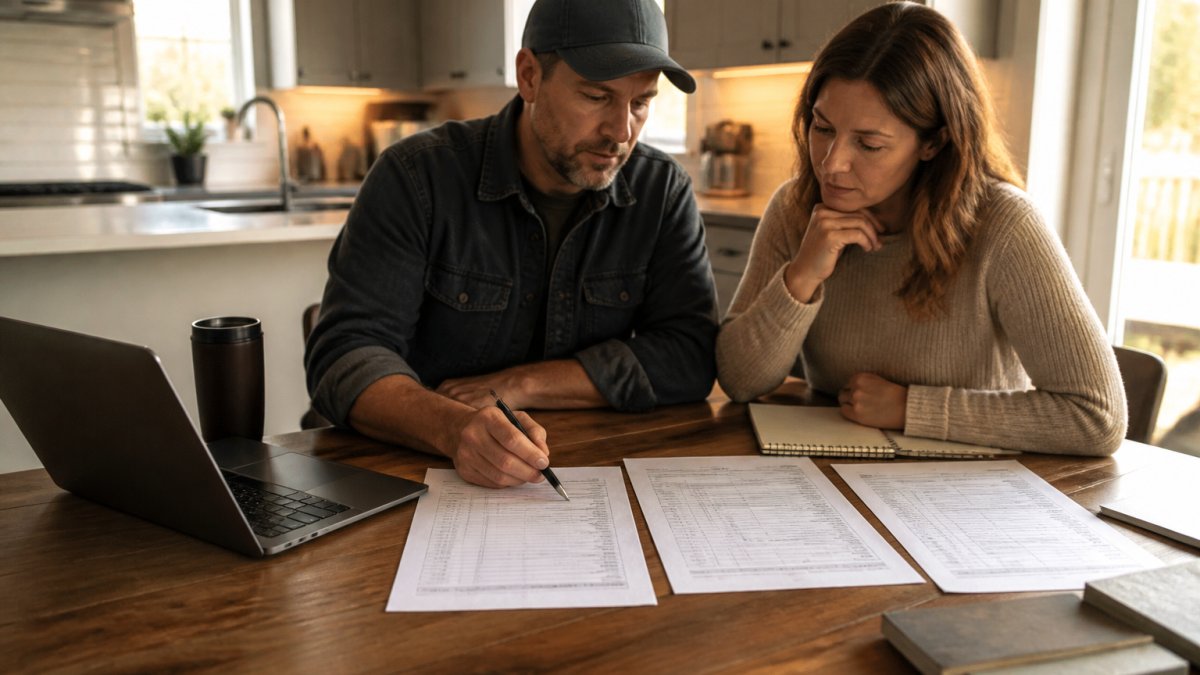
Normalize Every Bid Into One Worksheet
Normalizing means rewriting each bid into the same categories before you judge price. Build the worksheet once, then fill it in for every builder using these fixed rows.
| Worksheet Row | What to Record | Why It Matters |
|---|---|---|
| Plans and spec version | Drawing date and revision | Confirms same scope |
| Site work | Clearing, grading, utilities | Often excluded |
| Foundation | Type, waterproofing | Big cost swing |
| Framing and shell | Lumber grade, sheathing | Hidden quality gap |
| Mechanical, electrical, plumbing | Fixtures, brands, counts | Allowance trap |
| Finishes | Level, brands, quantities | Where bids diverge |
| Allowances | Dollar amount and item | Compare apples to apples |
| Exclusions | Written list | Prevents surprises |
| Contingency | Percent or dollar figure | Reveals risk buffer |
| Payment schedule | Draw milestones | Cash-flow check |
| Quote validity | Expiration date | Protects against drift |
Fill every cell, a blank cell is a question, not a zero. If Builder A lists "driveway: excluded" and Builder B lists "driveway: included," do not treat the gap as a discount.
A Worked Example: Reconciling Two Bids
Suppose two builders price the same 2,800-square-foot plan: Builder A at $612,000 and Builder B at $648,000. On the surface, A looks $36,000 cheaper. Normalize before you believe it.
- Builder A excludes the driveway and landscaping, which the site plan shows are required. Builder B includes both. Using a local site-work quote, those items add roughly $28,000 to A's real number.
- Builder A carries a $12,000 tile allowance; Builder B carries $22,000. If your selections price at $22,000, A's true cost rises by $10,000.
- Builder A lists a 5% contingency; Builder B lists 10%. On a $600,000 base, that is a $30,000 difference in risk buffer, not in price.
After normalization, A's adjusted total is closer to $650,000 and B's is $648,000. The "cheaper" bid was a smaller number with the missing work moved off the page. Run this exercise for every bid before you rank them.
Test Allowances Against Real Selections
Allowances are the most common place a bid diverges without looking like it. Price three real options for each major allowance at a local showroom or supplier, cabinets, tile, plumbing fixtures, lighting, countertops, and compare them to the allowance figure. If your taste runs above the allowance, the overage is your cost, not the builder's.
Update the worksheet so all bids reflect the same real selections, then compare totals.
Builder Quote Exclusions and Allowances: What They Hide
Exclusions and allowances are where builder quotes hide their real cost. An exclusion is work the builder will not do.
Both are normal. Both are also where a low bid gets its shine.
Read the exclusions page first. Common ones include permits, site work, landscaping, driveways, utility connections, and cleanup.
Allowances need the same scrutiny. A tile allowance of one amount versus another changes the total without changing the bid sheet.
Verifying Allowances Against Real Selections
Verification means checking each allowance against actual products you can buy today. Price three real options for cabinets, tile, and plumbing fixtures at a local showroom or supplier and compare them to the allowance figure.
If your taste runs above the allowance, the overage is your cost, not the builder's.
Do this for every allowance line. Then update the worksheet so all bids reflect the same real selections.
Custom Home Building Cost Breakdown: Labor, Materials, and Subcontractor Bids
A custom home building cost breakdown separates three cost pools: labor, materials, and subcontractor quotes. Each behaves differently and needs its own check.
Labor is hours times rate, ask for hours by trade where the builder will share them. Materials are quantities times unit price.
- Labor: hours and rate per trade
- Materials: quantities, brands, and unit prices
- Subcontractor quotes: number of trades bid and dates collected
- Overhead and profit: stated as a percent or dollar figure
- Contingency: the builder's risk buffer
A cost-plus contract shows these pools openly; a fixed-price contract bundles them, so ask what assumptions sit inside the number.
Site-Specific Costs and Risk Factors
Site conditions are the largest source of quote variation that never appears on a finish schedule. Two builders pricing the same plan on the same lot can differ by tens of thousands of dollars based on what they assume about the ground and access. Review these assumptions line by line:
- Soil and geotechnical report: has one been done, and does the bid assume rock, expansive clay, or high water table?
- Access and staging: is there room for deliveries, equipment, and a dumpster, or does the bid assume a narrow lot with off-site staging?
- Utilities: distance to tap water, sewer, gas, and electric, and who pays trenching and connection fees?
- Grading and drainage: is erosion control, retaining walls, or a engineered drainage plan included?
- Permits and impact fees: which are included, and at what assumed valuation?
- Weather and schedule: does the bid assume a normal season, and what delay clause applies?
Ask each builder to state these assumptions in writing. Where one bid assumes a standard foundation and another assumes rock excavation, the gap is a site-risk difference, not a price difference. Normalize it before ranking.
Contract and Change-Order Protections
A quote is only a number until the contract gives it teeth. The bid's assumptions should carry into the signed agreement, and the change-order clause should state how changes are priced and approved. Confirm in writing: a plainly stated fixed or cost-plus structure, a draw schedule tied to milestones, a written change-order process with markup stated, a completion date and delay clause, a warranty term and punch-list process, and lien waivers from subcontractors at each draw.
Spotting Lowball Estimates and Missing Items That Become Change Orders
A lowball estimate wins on price by leaving work out or pricing it too thin.
Spot it by comparing scope, not totals. If one bid is far below the others on the same plans, find out why before you celebrate.
Missing items are the quiet version of the same problem. Look for these gaps:
- Permits and inspection fees
- Site work, grading, and erosion control
- Utility trenching and connections
- Temporary power and site toilet
- Final cleaning and debris hauling
- Landscaping and hardscape
Each missing item becomes a change order, and change orders carry their own markup and schedule delay.
FTC consumer advice on home improvement contracts explains your right to a written contract and warns about high-pressure bids.
Questions to Ask a Custom Home Builder Before You Sign
The right questions expose how a builder thinks, not just what they charge. Ask them before you compare finalists, and write down the answers.
- Can I see the full plans and specifications your bid is based on?
- Which items are excluded, and what would they cost to add?
- What allowance amounts did you use, and what happens if I exceed them?
- How do you handle change orders, and what markup applies?
- Who manages the schedule, and how often do I get updates?
- How do you protect an occupied home or an operating business during work?
- What is your process for verifying subcontractor quotes?
On occupied sites, the answer matters. A builder who works in lived-in homes and open businesses plans dust control, staging, and hours around the people inside. Master Builder llc. builds the ability to work efficiently on occupied and fully operational job sites into the plan from day one, ensuring minimal disruption.
Contract Terms, Payment Schedules, and Change-Order Protections
Contract terms decide who carries risk when the unexpected shows up.
Start with the payment schedule. Progress draws should match completed work, not a calendar.
Then check the change-order clause.
Confirm these items in writing:
- A fixed or cost-plus structure, stated plainly
- A draw schedule tied to milestones
- A written change-order process with markup stated
- A completion date and a weather or delay clause
- A warranty term and a punch-list process
- Lien waivers from subcontractors at each draw
HUD's guidance on homebuying and construction resources is a useful starting point for understanding your protections and paperwork.
A quote is only a number until the contract gives it teeth.
Frequently Asked Questions
How do you compare quotes from custom home builders when the scopes are different?
You normalize them first. Put every bid into one worksheet with the same line items: site work, permits, foundation, framing, mechanicals, finishes, contingency, overhead and profit. Where a builder bundled items, ask for a split. Where one bid includes something the others exclude, add that cost to the others as a line item. Only after every bid covers the same scope can you compare builder quotes on price. If a builder will not itemize, treat the bid as incomplete rather than cheap.
How do allowances and exclusions affect a builder quote?
Allowances are placeholder dollar amounts for items you have not selected yet, such as tile, lighting, or plumbing fixtures. If the allowance is set low, your actual selections will push the price up through change orders. Exclusions are items the builder simply will not do, like landscaping, driveway paving, or utility trenching. Add every exclusion's real cost back into the bid and compare allowances against local supplier pricing before you rank the quotes.
Should I choose the lowest quote for a custom home?
Not on price alone. A low bid often reflects a thinner scope: missing site work, low allowances, no contingency, or a price per square foot measured on heated area only rather than under-roof area. Compare the lowest bid line by line against the others, confirm what is excluded, and ask the builder to explain any gap larger than about 10 percent. The cheapest number frequently becomes the most expensive project once change orders land.
What questions should I ask a custom home builder before signing?
Ask who pulls the permits, who supervises subcontractors daily, how change orders are priced and approved, what the payment schedule is tied to, and how long the quote stays valid. Request the last three projects the builder completed at a similar finish level and ask to walk one. Confirm whether the contract is fixed-price or cost-plus, and get the allowance list and exclusions in writing. Vague answers on any of these are a reason to keep comparing.
Comparing custom home builder quotes is a discipline, not a gut call. It asks for complete plans, a normalized worksheet, honest allowances, and a contract that protects you when the unexpected arrives. Master Builder llc. brings an end-to-end process to that work: collaborative planning with your architect, clear communication at every stage, and the staffing to keep a project moving on occupied sites. Get started with Master Builder llc. and compare bids on a level field.