
 how-to
7 Best Practices for Office Furniture Storage During Construction
Last Updated: October 28, 2026
Quick Summary
Best practices for furniture storage during construction start with a written plan covering the route, protection, and pickup schedule, then choosing off-site storage for long or dusty projects. Wrap each piece in stretch wrap and moving blankets, label it, and log it on an inventory template with condition notes before anything moves.
- Off-site storage suits long or uncertain timelines and protects against construction dust and debris.
- Wrap surfaces in stretch wrap, then moving blankets, and label every piece with its room and destination.
- An inventory template records item ID, description, condition, origin, destination, and status for each piece.
- Heavy files and binders go low on heavy-duty shelving; light items and decor go high.
- Ask whether storage is climate controlled and what the insurance covers and excludes before signing.
Table of Contents
- Start With a Plan: Site Preparation and Delivery Logistics
- On-Site vs. Off-Site Furniture Storage: Which Fits Your Project
- How to Protect Furniture During Construction
- Build an Office Furniture Inventory Template Before Anything Moves
- Choosing Storage Based on Load Requirements and Cabinet Quality
- Your Office Furniture Moving Checklist, Step by Step
- Climate Control, Insurance, and the Mistakes That Cost the Most
- Book a Walkthrough With Master Builder LLC
- Frequently Asked Questions
Start With a Plan: Site Preparation and Delivery Logistics
Every good furniture storage plan starts before the first chair leaves the floor. Best practices for office furniture storage during construction involve both logistics and storage.
The work begins with a simple question: what moves, when, and where does it land? Answer that in writing before demolition starts.
Site preparation covers three things:
- A marked path from each office to the loading zone
- Protection on floors, door frames, and elevator interiors
- A written schedule for pickup and delivery days
Delivery logistics matter just as much. Time your pickups around construction milestones so furniture never sits in a hallway waiting for a crew that isn't ready.
Clear the Path: Access Requirements and Floor Plan Layout
Measure the route before you move anything.
Walk the path with your contractor and mark it on the floor plan.
Access rules matter on active sites too. Confirm which entrances stay open, where trucks can park, and what hours deliveries are allowed.
For the bigger picture on phasing work around an active business, see our guide to commercial renovation planning for small businesses.
On-Site vs. Off-Site Furniture Storage: Which Fits Your Project
Off-site storage wins for most occupied renovations, but on-site works in specific cases. The right choice comes down to space, timeline, and how much dust and traffic the furniture will face.
On-site storage makes sense when:
- The project is short and the furniture stays in a sealed room
- You have a spare, lockable space away from active work
- Reinstalling quickly matters more than protection
Off-site storage fits better when:
- Construction dust and debris will reach the storage area
- The timeline is long or uncertain
- You need climate control and secure access
On-site saves on hauling. Off-site saves on damage.
If your team stays in the building during the work, our article on renovating occupied office space without disruption covers how to keep both running at once.
How to Protect Furniture During Construction
Protection starts with the wrap, not the truck. Dust, moisture, and knocks cause most furniture damage on construction sites, and each one has a simple fix.
Follow this order:
- Empty every drawer, shelf, and cabinet
- Disassemble what comes apart easily
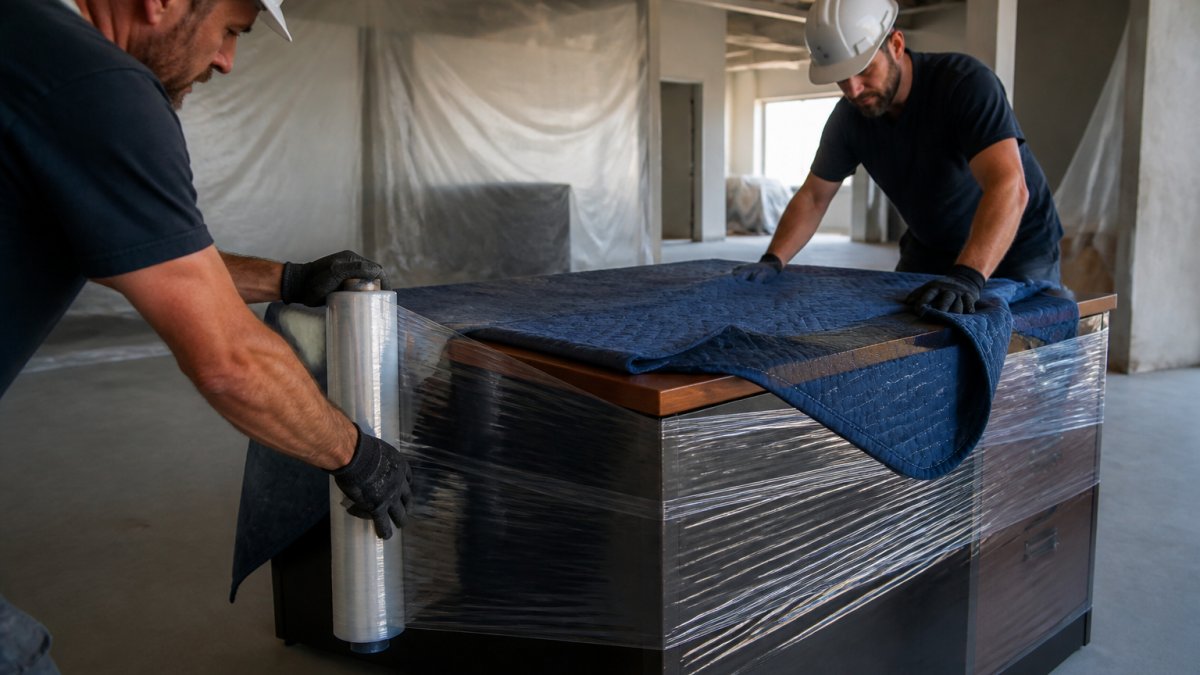
- Wrap surfaces in stretch wrap, then moving blankets
- Label every piece with its room and destination
- Stack only what can bear weight
Protective Packaging Standards That Actually Hold Up
Good packaging is layered. Stretch wrap seals out dust and holds drawers shut. Moving blankets absorb impact.
Skip the thin single-layer wrap. It tears on the first sharp corner and lets grit inside.
Label every wrapped item on the outside, not the inside. A marker on the wrap saves you from unwrapping twelve desks to find the one you need.
Match the Wrap to the Hazard
Not every piece needs the same treatment. Match the packaging to what the construction site will throw at it:
- Fine dust from drywall and concrete cutting: seal seams with tape and use stretch wrap rated for puncture resistance. Plastic sheeting over the top of a stack adds a second barrier.
- Moisture from wet trades or humid months: add a desiccant pack inside sealed wrap on wood and upholstered pieces, and keep wrapped items off bare concrete floors.
- Impact from carts, ladders, and foot traffic: moving blankets plus rigid corner protectors on desks, casegoods, and monitor arms.
- Glass and laminate surfaces: foam sheets under blankets; never let stretch wrap touch a laminate edge directly, because trapped grit scratches under pressure.
Construction-Site Packaging Sequence
A common pattern on occupied jobs is to wrap in place, then move. That order keeps furniture out of the traffic path longer than necessary. The better sequence is:
- Clear and protect the route first (floor runners, door-frame guards, elevator pads).
- Wrap and blanket each piece at its original location.
- Move wrapped items directly to the loading zone or sealed on-site room.
- Re-wrap any item that will sit more than a few days, because construction dust settles on exposed blankets.
What Not to Do
- Do not use household plastic wrap or trash bags as a dust barrier; they tear and trap moisture.
- Do not stack wrapped chairs on wrapped desks; point loads crack tops.
- Do not leave wrapped furniture in an unsealed room next to active drywall sanding.
- Do not write labels only on the blanket; blankets get reused and labels get lost. Label the wrap and the piece.
Build an Office Furniture Inventory Template Before Anything Moves
An inventory list is the single best protection against lost furniture. Build it before the first item leaves the floor, and update it at every step.
Your office furniture inventory template needs these columns:
| Column | What to Record |
|---|---|
| Item ID | A number or tag on each piece |
| Description | Type, size, color, material |
| Condition | Note existing damage before the move |
| Origin | Room and floor it came from |
| Destination | Where it goes after construction |
| Status | Stored, in transit, reinstalled |
Photograph each item next to its tag. This record settles any later question about pre-existing damage and makes reinstalling far faster.
A common mistake is skipping the condition notes. Without them, you can't tell what the move caused and what was already there.
Choosing Storage Based on Load Requirements and Cabinet Quality
Storage fails when it can't carry the weight. Match every shelf and cabinet to what you put on it, and check the load-bearing capacity before you load a single box.
Use these rules:
- Heavy files and binders go low, on heavy-duty shelving
- Light items and decor go high
- Freestanding cabinets need level floors and wall anchors
- Stacked items must be secured against sliding or collapse
The federal rule for stacked materials is clear: secure tiers so they cannot slide, fall, or collapse, per OSHA's materials storage standard.
Quality cabinets pay off here. A flimsy shelf that bows under binders can drop a whole row. Buy for the load, not the price tag.
Your Office Furniture Moving Checklist, Step by Step
A written checklist keeps the move on schedule and stops items from vanishing. Here is a sequence to consider for occupied jobs.
- Two weeks out: finish the inventory, book storage, confirm access
- One week out: order wrap, blankets, labels, and carts
- Day before: clear the path, protect floors, stage boxes
- Move day: wrap, label, load, and log each item out
- At storage: check items in against the list
- Reinstall: match tags to the new floor plan layout
For the wider project timeline, our commercial construction project management tips show how the move fits into the build schedule.
Climate Control, Insurance, and the Mistakes That Cost the Most
Two things sink furniture storage plans: moisture and missing coverage. Wood swells, metal rusts, and upholstery holds damp. Climate-controlled storage prevents most of it.
Ask these questions before signing a storage contract:
- Is the space climate controlled?
- What does the insurance cover, and what does it exclude?
- Who is liable for damage in transit versus in storage?
- How is access controlled and logged?
Potential mistakes include:
- Storing furniture in an unheated space through humid months
- Assuming the mover's insurance covers everything
- Losing track of items because no one kept the list current
- Stacking heavy items on light shelving
Watch out: a storage contract that excludes water damage can leave you paying for a whole office of ruined furniture. Read the exclusions before you sign.
Climate Control: What to Ask and Why It Matters
Active construction changes the indoor environment hour to hour. Drywall dust, curing concrete, and open doors let humidity and temperature swing.
A climate-controlled space typically holds temperature and relative humidity within a stable band. Ask the storage provider:
- What temperature and humidity range do you maintain, and how is it monitored?
- Is the space sealed from construction dust, or is it in the same building as active work?
- Are items stored off the floor on pallets or shelving?
- How often are conditions logged, and can you see the logs?
If off-site climate control is not in the budget, a sealed on-site room with a dehumidifier and filtered air is the next best option for short projects. Keep wrapped wood and upholstered pieces off bare concrete, which wicks moisture.
Insurance and Liability: Transit vs. Storage
Coverage is rarely one policy. Three parties usually touch the furniture: the mover, the storage facility, and your own commercial property policy. Each covers a different window, and gaps between them are where losses land.
Ask these questions in writing:
- Transit: Does the mover carry cargo insurance, and what is the deductible and per-item limit? Is there a released-value option that lowers cost but caps payout?
- Storage: Does the facility's coverage apply only while items are inside the unit, or also during loading and unloading?
- Your policy: Does your commercial property coverage extend to off-site storage, and does it require a scheduled list of items?
- Subrogation: If the mover damages an item and your insurer pays, will your insurer pursue the mover, or will you be caught between them?
Inventory as Insurance
The inventory template is not just organization; it is claim evidence. Photograph each item next to its tag before the move, note existing damage in the condition column, and keep the log current at every handoff. Without that record, an insurer or mover can dispute what was damaged and when.
Mistakes That Cost the Most
- Storing furniture in an unheated space through humid months
- Assuming the mover's insurance covers everything
- Losing track of items because no one kept the list current
- Stacking heavy items on light shelving
- Skipping the condition notes, which makes damage claims unwinnable
- Leaving wrapped furniture in an unsealed room next to active drywall sanding
Book a Walkthrough With Master Builder LLC
Planning the storage and the build together can help address coordination between the work and the construction schedule.
Our verified capabilities include:
- End-to-end project management from planning to final execution
- Ability to work on occupied and fully operational job sites
- A collaborative approach with your architect and designers
Not sure how to choose the right contractor for the job? Read our guide on hiring a general contractor for office renovations first. Then reach out through our contact page to get started.
Frequently Asked Questions
Should office furniture be stored on-site or off-site during construction?
The choice depends on the scope of work and the timeline. Consider the available space, schedule, and how the construction work may affect furniture, then decide.
How do you protect office furniture from dust during a renovation?
Furniture protection during construction depends on the project and the items involved. Consider how the work area and schedule may affect furniture before deciding how to protect it.
How should you label and inventory furniture before moving it?
An inventory can record each item's description, condition, origin, destination, and status. Consider documenting existing damage before the move.
Can office furniture be stored in a construction area?
Whether furniture can be stored in a construction area depends on the project and the space available. Consider the work area and construction schedule when planning where furniture will be kept.
Your furniture shouldn't be the casualty of a good renovation. Get the storage plan, the schedule, and the crew aligned before demolition day. Get started with Master Builder llc. and keep your office running while we build the space it moves back into.