 blog
Refinish or Replace Hardwood Floors: Cost Guide
Quick Summary
Hardwood floor refinishing is usually cheaper than replacing the floor, typically costing $3 to $8 per square foot compared with roughly $6 to $25 per square foot for new hardwood installation. Refinishing works only when the boards are solid and have enough wear layer left to be sanded again.
- Refinishing typically costs $3 to $8 per square foot, according to NerdWallet's 2026 flooring cost guide.
- Full replacement commonly runs $8 to $15 or more per square foot, per A.O. Saves Wood Floors' 2026 guide.
- One contractor estimates refinishing is cheaper in 80 to 85 percent of cases, at 25 to 50 percent of replacement cost.
- Refinishing requires enough wood above the tongue, about 1/16 inch for solid hardwood, to be sanded safely.
- Compare bids by pricing the same square footage and scope, with removal, disposal and repairs itemized.
Table of Contents
- Hardwood Floor Refinishing vs Replacement: The Core Cost Difference
- Hardwood Floor Refinishing Cost per Square Foot
- Hardwood Floor Replacement Cost per Square Foot
- A Side-by-Side Cost Calculator for Your Floor
- When to Refinish or Replace Hardwood Floors
- Hardwood Floor Refinishing Timeline and Disruption
- Booking Your Floor Assessment With Master Builder llc.
- Frequently Asked Questions
Hardwood Floor Refinishing vs Replacement: The Core Cost Difference
Last Updated: October 29, 2026
Homeowners facing worn hardwood often ask one question first: is hardwood floor refinishing cheaper than replacing the floor? In most cases, yes. Published contractor estimates put refinishing at about $3 to $8 per square foot, while new hardwood installation runs roughly $6 to $25 per square foot, according to BigBro Hardwood's 2026 cost comparison. That gap is the core of the decision.
The gap is not the whole story, though. Refinishing sands down the top layer of wood and applies new finish. It works only when the boards are solid and thick enough to take another sanding. Replacement removes the old floor entirely and installs new material, which adds labor, disposal and sometimes subfloor work.
A flooring contractor cited by Fabulous Floors USA's 2026 refinish-versus-replace guide says refinishing is the cheaper option in 80 to 85 percent of cases, typically costing 25 to 50 percent of full replacement. Treat that figure as one contractor's estimate rather than a national survey. Still, it points in the same direction as the other published numbers.
The sections below walk through both sides.
Hardwood Floor Refinishing Cost per Square Foot
Hardwood floor refinishing typically costs $3 to $8 per square foot, according to NerdWallet's 2026 flooring cost guide. The final number depends on floor size, wood species, labor rates and the finish you choose.
Measure the room and compare bids on the same scope of work.
Hardwood Floor Replacement Cost per Square Foot
Replacing hardwood usually costs more than refinishing, and the range is wider. Restoration publishers commonly estimate full replacement at $8 to $15 or more per square foot, as A.O. Saves Wood Floors' 2026 restoration-versus-replacement guide reports. Installing new hardwood alone is often quoted between $6 and $25 per square foot, depending on species and grade.
A Side-by-Side Cost Calculator for Your Floor
Most published comparisons give you two broad ranges and leave you to guess what is inside them. That is not a real comparison. A like-for-like calculator has to price the same floor area and the same scope on both sides, with labor, materials, removal, disposal, repairs, and finishing itemized separately. Use the worksheet below to build that comparison for your own room.
Step 1: Measure the same area on both sides
Measure the finished floor area in square feet, excluding stairs and closets unless you plan to include them. Use the same number for both columns. If you are comparing a partial refinish against a full replacement, note the percentage of the floor each scope covers so the totals stay comparable.
Step 2: Itemize the scope
| Line item | Refinishing | Replacement |
|---|---|---|
| Square footage priced | Same measured area | Same measured area |
| Labor (sanding, prep, installation) | Per square foot or hourly | Per square foot or hourly |
| Materials (finish, stain, sealant) | Finish and stain quantities | New flooring, adhesive, fasteners |
| Removal and demolition | Usually none | Tear-out of existing floor |
| Disposal and haul-away | Usually none | Dumpster or hauling fee |
| Repairs (boards, subfloor) | Board replacement, patching | Subfloor repair, leveling |
| Trim and transitions | Baseboard removal and reinstall | Baseboard, thresholds, stair nosing |
| Dust control and protection | Containment, plastic, tape | Containment plus debris control |
| Finishing | Stain and polyurethane coats | Factory finish or site finish |
| Stairs (if applicable) | Priced per tread and riser | Priced per tread and riser |
Step 3: Apply rates to the same scope
Use the per-square-foot ranges from the sections above as starting points, then adjust each line with the contractor's actual numbers. For example, a 400-square-foot living room refinish at $3 to $8 per square foot gives $1,200 to $3,200 before add-ons. A replacement at $8 to $15 per square foot gives $3,200 to $6,000 or more. Add the itemized repair, trim, stair, and disposal lines to both columns before you compare totals.
Step 4: Add the hidden-cost lines competitors skip
These items rarely appear in advertised ranges but show up on real invoices:
- Furniture moving: moving and storing furniture from the work area, often billed hourly.
- Baseboards and trim: removal and reinstallation, sometimes with new material if the old trim breaks.
- Subfloor repairs: patching, leveling, or replacing damaged plywood before either option.
- Transitions and stair nosing: matching new material to adjacent rooms and stairs.
- Dust control: containment barriers, negative air machines, and post-job cleaning.
- Temporary accommodation: hotel or rental costs if the home is uninhabitable during curing.
Step 5: Compare total ownership, not just day-one cost
A refinish that lasts 10 to 15 years and a replacement that lasts 25 to 30 years are not equal values at the same price. Divide each total by its expected service life to get a rough annual cost, then weigh that against appearance, disruption, and the risk of a second project later.
When to Refinish or Replace Hardwood Floors
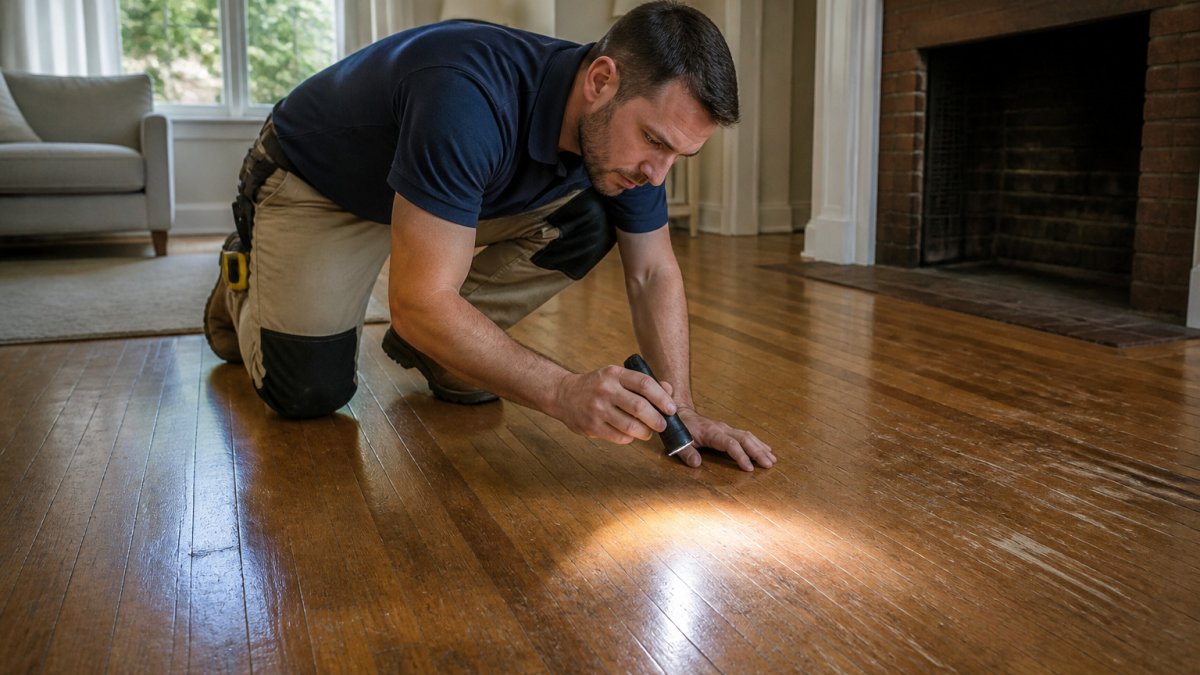
The refinish-or-replace decision is not only about damage. It is about whether your specific floor can survive another sanding and whether the damage is in the finish or in the wood. Use the inspection checklist below to sort your floor into one of three outcomes: refinish, replace, or borderline.
First, identify what kind of floor you have
Check a floor register, a transition strip, or a closet edge to see the cross-section. If you see a continuous piece of wood, it is solid. If you see layers, it is engineered, and the top layer is your veneer.
Second, estimate how much wear layer is left
A common rule of thumb is that solid hardwood needs about 1/16 inch of wear layer above the tongue to take another sanding. Engineered floors need enough veneer to sand without exposing the core. Prior sandings matter: each refinish removes a small amount of surface, so a floor that has been sanded three times has less margin than one that has never been touched. Ask the seller or previous owner for refinishing history if you can, and have a contractor probe the thickness at a few inconspicuous spots.
Third, inspect for the damage patterns that decide the outcome
| Condition | What it usually means | Likely path |
|---|---|---|
| Surface scratches, dull finish, fading | Damage is in the finish, not the wood | Refinish |
| Light cupping that flattens after humidity normalizes | Moisture imbalance, not structural failure | Refinish after moisture control |
| Deep cupping, buckling, or boards lifting | Moisture intrusion or subfloor movement | Replace and fix the cause |
| Dark water stains that do not sand out | Stain has penetrated the wood | Replace affected boards or the floor |
| Rot, soft spots, or crumbly wood | Structural decay | Replace |
| Isolated deep gouges or pet damage | Localized damage | Replace boards, then refinish the rest |
| Widespread damage across most of the floor | Repair cost approaches replacement | Replace |
Fourth, weigh the borderline cases
Some floors sit between the two paths. A floor with damage in one room but sound boards elsewhere may be a candidate for a partial replacement plus a refinish of the remaining area. A floor with a thin veneer but only surface wear may be a candidate for a screen-and-recoat, which scuffs the finish and applies a new topcoat without deep sanding. A floor with prior sandings but no current damage may be worth refinishing once more if a contractor confirms there is enough wear layer.
Fifth, match the decision to the room and the plan
Our team at Master Builder llc. can probe the wear layer, check moisture levels, and inspect the subfloor before you commit to either path.
Hardwood Floor Refinishing Timeline and Disruption
For a broader view of how flooring fits into a renovation schedule, see our residential construction project timeline breakdown.
Booking Your Floor Assessment With Master Builder llc.
Master Builder llc. can work on occupied and fully operational job sites. We collaborate with architects and designers.
If you want to discuss a construction project, contact us to request a quote. Before you compare bids, our guide on how to spot red flags in contractor estimates can help you read them clearly. And to compare contractor proposals on equal terms, see how to compare custom home builder quotes.
Frequently Asked Questions
Is it cheaper to refinish a wood floor or replace it?
In most cases, yes. Published 2026 estimates put hardwood refinishing at $3 to $8 per square foot, while new hardwood installation runs about $6 to $25 per square foot, according to BigBro Hardwood. One contractor cited in the research says refinishing is cheaper in 80 to 85 percent of cases and typically costs 25 to 50 percent of full replacement. Replacement becomes more competitive when boards are cracked, warped, or badly water-damaged, so have a professional confirm the floor's condition before you choose.
How much does it cost to refinish 1,000 square feet of hardwood floors?
At the commonly cited range of $3 to $8 per square foot, refinishing 1,000 square feet would run roughly $3,000 to $8,000 before extras. Fabulous Floors USA reports a narrower $3.50 to $6.50 per square foot for a full sand and finish in most U.S. markets. Stairs, repairs, carpet removal, and stain changes can add to the total, so ask any contractor for an itemized estimate.
When should you not refinish hardwood floors?
Refinishing is usually a poor choice when the boards are too thin to sand again, when there is structural damage or rot, or when water damage has penetrated the subfloor. One contractor cited in the research argues replacement can be more cost-effective when more than 30 percent of the floor is damaged, though that threshold is a contractor's rule of thumb rather than an industry standard. Get a floor assessment before committing to either path.
How long does hardwood floor refinishing take compared with replacement?
Refinishing is generally the faster project because the existing boards stay in place and only the finish is removed and reapplied. Replacement requires removing the old flooring, preparing the subfloor, and installing new boards, which takes considerably longer. Exact timing depends on square footage, room count, and drying time between coats, so request a schedule with your estimate.