 listicle
9 Best Flooring Options for Homes with Pets
Last Updated: November 1, 2026
Quick Summary
The best flooring for pets in 2026 is rigid-core luxury vinyl plank, with porcelain tile close behind for high-traffic zones. Waterproof cores and scratch-resistant wear layers matter most, since pet accidents damage the subfloor rather than just the surface. Choose flooring for pets by matching it to your pet's age, size, and habits.
- Rigid SPC vinyl cores are fully waterproof and do not swell, making LVP the top overall pick.
- Specify a 20 mil wear layer on hallways, the highest nail-traffic runway in most homes.
- Porcelain tile is scratch-resistant and waterproof, but grout needs sealing and the surface is hard and cold.
- Keep a box of spare planks or tiles from the original lot for small pet-related repairs.
- Standard laminate cores swell when moisture reaches the seams, and one overnight accident can void the warranty.
Table of Contents
- Quick Comparison: Best Flooring for Homes with Pets
- Waterproof Flooring for Pets: Why It Matters More Than Stain Resistance
- 1. Luxury Vinyl Plank and Tile: The All-Around Winner
- 5. Tile, Hardwood, Carpet, and Cork: Pros and Cons for Pet Homes
- Choosing the Right Pet Flooring for Your Remodel
- Frequently Asked Questions
Quick Comparison: Best Flooring for Homes with Pets
The best flooring for homes with pets in 2026 is rigid-core luxury vinyl plank, with porcelain tile close behind for high-traffic zones. Three questions decide most pet-friendly flooring choices: does it survive water, does it survive claws, and can you actually clean it?
Here is the short version before the details:
| Flooring Type | Waterproof? | Scratch Resistance | Best For |
|---|---|---|---|
| Luxury vinyl plank (LVP) | Yes, rigid SPC cores are fully waterproof | High, with a thick wear layer | Most pet homes, dogs and cats alike |
| Porcelain and ceramic tile | Yes | Very high | Mudrooms, kitchens, heavy-traffic zones |
| Laminate | Water-resistant to waterproof grades | Moderate to high | Budget-conscious buyers |
| Engineered hardwood | No | Low to moderate | Low-traffic, well-managed homes |
| Carpet (frieze, plush) | No | Low | Bedrooms and stairs |
| Cork | No | Low | Quiet, cushioned comfort |
Below, we break down each option, the trade-offs nobody mentions, and how to match a floor to your pet's age and habits.
Waterproof Flooring for Pets: Why It Matters More Than Stain Resistance
Waterproof flooring for pets matters more than stain resistance because pet accidents damage the subfloor, not just the surface. A stain sits on top.
That distinction reshapes the whole shopping list. According to Viva Floors' 2026 pet-friendly flooring guide, waterproof luxury vinyl plank tops its ranking for most pet owners, ahead of porcelain tile, laminate, and engineered hardwood.
Waterproof flooring for pets is any floor whose core and seams resist liquid penetration long enough for routine cleanup, typically rigid-core vinyl or tile. Water-resistant floors slow moisture down but still need fast attention.
Waterproof surface vs. waterproof floor
A waterproof plank and a waterproof floor are not the same thing. The plank can be fully waterproof and the floor can still leak. The failure points are predictable:
- Seams between planks or tiles. Rigid-core LVP clicks together tightly, but an unsealed seam at a water-bowl station can pass liquid under repeated exposure. Tile is waterproof at the surface; grout is the weak point unless sealed or epoxy-based.
- Perimeter gaps and expansion joints. Floors need room to move, and that wall gap is a direct path to the subfloor if a spill pools there.
- Subfloor and underlayment. A waterproof wear layer over a moisture-sensitive subfloor still fails if water reaches the subfloor. In slab-on-grade homes, moisture can also come up from below.
Repairability: how a damaged floor actually gets fixed
Repairability is where pet flooring decisions pay off or punish you years later.
- Floating rigid-core LVP. A damaged plank can often be cut out and replaced, but matching dye lots and locking the new piece into the click system takes skill. Edge planks are far easier to swap than center planks.
- Glue-down LVP. Individual planks can be replaced, but the adhesive bond makes removal more labor-intensive.
- Porcelain and ceramic tile. A cracked tile can be chipped out and replaced if you kept spares from the same lot; grout color matching is the usual complication.
A practical rule: keep a box of spare planks or tiles from the original lot. Pet homes generate small repairs, and matching a discontinued product later is the expensive part.
What to check before you buy
- Read the warranty language on moisture and pet damage specifically; many warranties exclude damage from standing water or pet waste.
- Confirm the wear layer is thick enough for your pet's size and activity.
- Ask how seams and perimeter gaps will be sealed in wet zones.
Watch out: laminate sold as "water-resistant" can still swell at the seams if a spill sits overnight. Check the warranty language before you buy.
1. Luxury Vinyl Plank and Tile: The All-Around Winner
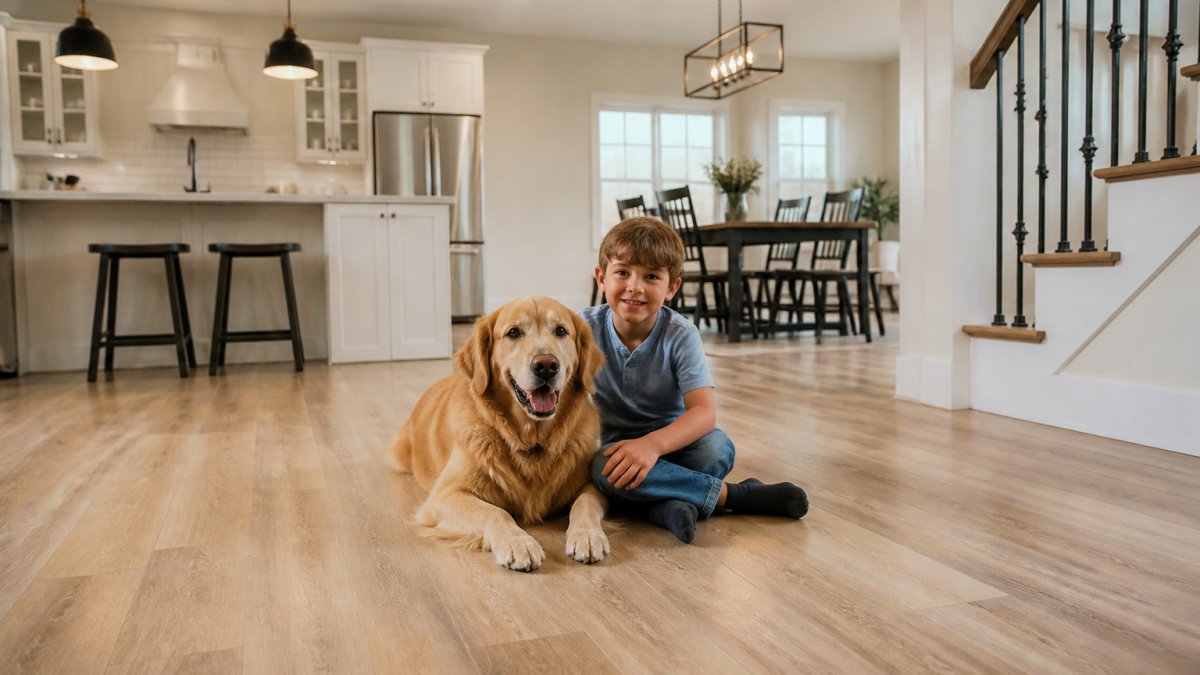
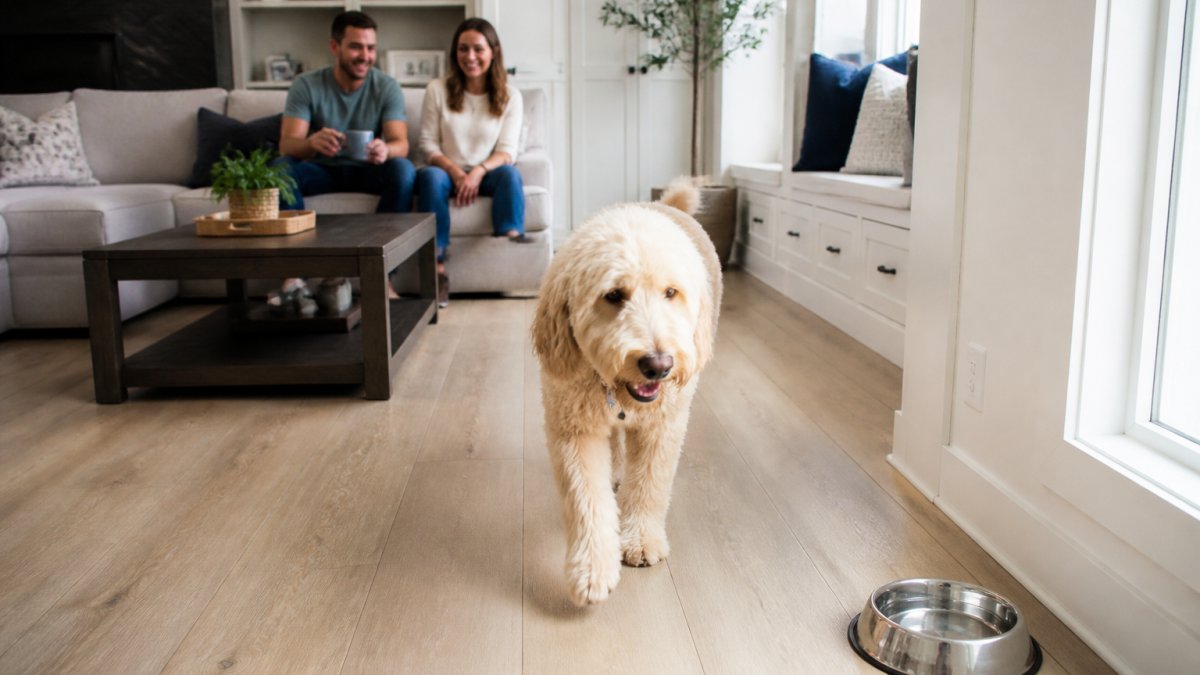
Luxury vinyl plank and luxury vinyl tile win for most pet households because they combine 100% waterproof cores with scratch-resistant wear layers and easy mopping. Rigid SPC vinyl, the stone-polymer composite core, is rated the best overall flooring for dogs and cats in Cavalieri Flooring's 2026 pet-friendly guide precisely because that core does not swell.
Where laminate still wins: price per square foot and a harder, more realistic wood look underfoot. Where it loses: a single overnight accident can void the warranty. For a puppy in training, that risk is real.
5. Tile, Hardwood, Carpet, and Cork: Pros and Cons for Pet Homes
Tile, hardwood, carpet, and cork each solve a different problem, and none wins across the board.
Porcelain and ceramic tile. Tile is commonly recommended for high-traffic areas with pets.
Hardwood and engineered wood. Beautiful, repairable, and warm. If you inherit hardwood, our guide to refinishing versus replacing hardwood floors explains when a sand-and-refinish is the smarter spend.
Carpet. Plush and frieze carpet cushion joints and quiet the house, which matters for senior dogs.
Cork. Cork is a soft, noise-reducing surface that cushions joints, though it dents under furniture and claws.
Choosing the Right Pet Flooring for Your Remodel
Choosing pet flooring during a remodel means deciding by pet, not by showroom sample. When you are ready to hire an installer, our guide on how to find a reliable general contractor walks through what to look for. It also helps to review a residential construction project timeline breakdown so you know how the flooring swap fits into the overall schedule. If you are weighing radiant floor heating in new builds, it is worth checking before you commit to a floor.
Decision matrix by pet type, age, and behavior
| Pet profile | Primary risk | Best floor | Acceptable alternative | Avoid |
|---|---|---|---|---|
| Puppy or kitten under 1 year | Frequent accidents, training-phase moisture | Rigid-core LVP throughout | Waterproof laminate in low-moisture rooms | Carpet, engineered hardwood |
| Large dog over 50 lb | Concentrated nail force, running landings | 20 mil wear-layer LVP or porcelain tile on running routes | Engineered hardwood in low-traffic rooms | Thin-mil LVP, solid hardwood |
| Senior pet with joint issues | Slipping, stiffness on hard surfaces | Textured tile in wet zones, cork or low-pile carpet in resting areas | LVP with slip-resistant finish | High-gloss tile, polished stone |
| Multiple cats | Vertical and horizontal scratching, hairballs | Porcelain tile in feeding areas, high-wear LVP elsewhere | Sealed concrete in utility zones | Loop carpet, plush carpet |
| Pet prone to accidents (incontinence, illness) | Standing moisture, odor in seams and padding | Rigid-core LVP with sealed seams | Porcelain tile with epoxy grout | Laminate, carpet with pad |
| Low-traffic, well-managed adult pets | Occasional scratches, normal wear | Engineered hardwood | High-wear LVP | , |
How to read the matrix
Start with the highest-risk row that applies. A household with a puppy and a senior cat should plan around the puppy's accident risk first, because moisture damage is expensive and hard to reverse, while scratch risk is cosmetic. Then layer comfort choices for the senior pet in resting areas only.
Three behavior questions narrow the choice faster than any sample:
- Does the pet have accidents indoors? If yes, the floor must be waterproof at the seams, not just the surface. That rules out standard laminate and most carpet.
- Does the pet sprint and turn? Running landings concentrate force on a few square inches. Specify a thicker wear layer and a textured finish on those routes.
- Does the pet slip on smooth surfaces? Older dogs and dogs with hip issues need texture and a slip-resistant rating; high-gloss tile is the wrong call regardless of how it looks.
Lifecycle cost, not sticker price
Budget the whole lifecycle. A common pattern in remodels:
- Porcelain tile carries the highest material and installation cost upfront, but it lasts decades and individual tiles can be replaced. Grout sealing is a recurring maintenance line.
- Rigid-core LVP sits in the middle on installed cost and lets you swap a damaged plank on a floating install without tearing out the room. Replacement cost per plank is low; the labor to redo a whole floor is not.
- Laminate is often the lowest installed cost, but a single overnight accident that reaches the seams can void the warranty and force a full replacement.
Ask your installer for the installed cost per square foot including underlayment, trim, and transitions, not the material price alone, and request a quote from Master Builder llc. on our website for current pricing. The gap between the two is where budgets fail.
Match the floor to the room, not the whole house
Most pet homes do best with a hybrid plan: waterproof rigid-core LVP or porcelain tile on running routes, entryways, kitchens, and water-bowl stations; cork or low-pile carpet only in bedrooms and stairs where comfort matters and accidents are unlikely. Floor the routes the pet uses daily before spending on rooms it visits occasionally.
Frequently Asked Questions
What is the best flooring for dogs?
Rigid SPC vinyl and luxury vinyl plank rank highest for dog owners. Both are 100% waterproof, resist scratches from nails, and clean up easily after accidents. Porcelain tile is a close second for high-traffic areas because it will not scratch, though it is harder underfoot. Engineered hardwood works better than solid hardwood in dog homes but still scratches over time. Match the choice to your dog's size and energy level before you commit.
Is vinyl or laminate flooring better for pets?
Vinyl usually wins for pets. Luxury vinyl plank is waterproof through its core, so pet accidents and spilled water bowls will not swell the planks. Laminate has improved, and waterproof laminate is now sold alongside LVP, but standard laminate still swells if moisture reaches the core. Vinyl also tends to feel warmer and quieter underfoot. Choose laminate only if you want a specific look and confirm the product is rated waterproof, not just water-resistant.
What flooring is easiest to clean after pet accidents?
Tile and luxury vinyl plank are the easiest to clean. Both have non-porous surfaces that wipe clean with a damp mop, and neither absorbs odors the way carpet does. Grout lines on tile need a brush now and then, while LVP seams are tight and simple to wipe. Carpet traps accidents in the pad and backing, so it is the hardest surface to fully deodorize. If accidents are frequent, skip carpet in the rooms your pet uses most.
Which flooring is least likely to show pet scratches?
Porcelain tile and ceramic tile will not scratch from pet nails at all. Among softer options, luxury vinyl plank with a thick wear layer hides fine scratches well, especially in matte finishes and mid-tone patterns that camouflage marks. Solid hardwood shows scratches most clearly because the finish sits on the surface. Engineered hardwood performs better than solid wood due to its more stable construction, but it still scratches. Lighter wood tones and textured surfaces hide wear better than dark, glossy finishes.
What type of flooring is best if you have cats?
Cats scratch, so pick a surface that resists claw marks and cleans up easily. Luxury vinyl plank and porcelain tile both hold up well. Bamboo is also cited as a top option for cat owners because it resists scratching from cats and large dogs. Avoid wall-to-wall carpet in scratching zones, since claws snag loops and fibers. For comfort, add washable rugs in the spots your cat likes to lounge rather than carpeting the whole room.